
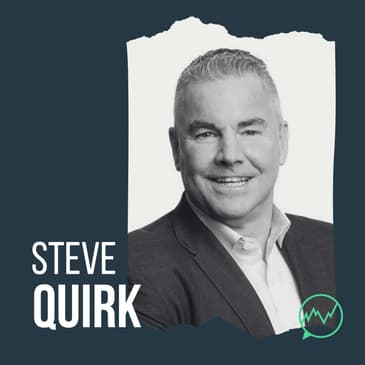
Steve Quirk began his career in 1987 on the fast-paced trading floors of Chicago, surviving the historic market crash that wiped out $1.7 trillion worldwide.
From navigating open-outcry pits where a trader's word was their bond, Steve transitioned into market technology, helping build landmark tools at thinkorswim and leading trading strategy initiatives at TD Ameritrade. Today, as Chief Brokerage Officer at Robinhood, he sits at the intersection of retail investing, market structure, and financial innovation, shaping products for millions of retail investors.
In this conversation, Steve shares key lessons from decades in the markets, the evolution of retail trading technology, and how removing friction like the Pattern Day Trader rule is unlocking the next era of retail investing.
In this episode, we explore:
• Steve’s early days in the Chicago trading pits in 1987
• Why decisive decision-making and accepting being wrong 50% of the time is crucial
• The transition from floor trading to building technology at thinkorswim
• How Robinhood levels the playing field for retail investors and opens up global access
• Managing risks: framing the absolute worst-case scenario before taking a trade
• The impact of removing the Pattern Day Trader (PDT) rule for retail traders
About Steve Quirk:
Steve Quirk is Chief Brokerage Officer at Robinhood Markets. With over 35 years of financial markets experience, he previously led trading strategy at TD Ameritrade, developed innovative trading tools for thinkorswim®, and created the TD Ameritrade U program. Steve started his career in 1987 in the Chicago open-outcry pits across the CME and CBOE, and is a frequent market commentator featured on CNBC, Fox Business, and The Wall Street Journal.
Links + Resources:
LinkedIn: https://www.linkedin.com/in/steve-quirk-56148a22/
X (Twitter): https://x.com/SteveQuirk_
Sponsor of Chat With Traders Podcast:
Trade The Pool: http://www.tradethepool.com
Time Stamps:
Please note: Exact times will vary depending on current ads.
00:00 From Chicago Pit Trader to Robinhood Exec
02:57 What Pulled You to the Market?
07:17 Trading Pits Are More Organized Than They Appear
11:51 Transitioning to Creating Technology for Retail Trading
19:01 Leveling the Playing Field for Retail Traders
21:10 Giving People What They Want
24:45 Did You Fall in Love with Scaling Robinhood Like You Did with Trading?
29:48 What Robinhood Is Doing to Teach
32:12 Early Mistakes in Trading
34:31 Advice to People from Robinhood CBO
36:44 What's Your Next Product Going to Be?
40:24 What Is the PDT Rule?
43:23 What Is a Memory That Came to Mind in Your Trading Career?
45:16 Is There Anything in Your Life That Changed Your Line of Thinking?
46:22 Your Piece of Advice to Your Younger Self
46:57 Where Can Traders Find You?
Trading Disclaimer:
Trading in the financial markets involves a risk of loss. Podcast episodes and other content produced by Chat With Traders are for informational or educational purposes only and do not constitute trading or investment recommendations or advice.
Learn more about your ad choices. Visit megaphone.fm/adchoices
[00:00:00] What would your trading look like if capital wasn't the constraint? That's the reality for most traders. It's not skill holding them back, it's size. Trade the pool changes that. Step into the US equity markets with up to $200,000 in buying power without committing your own capital. Full access to stocks and ETFs, long or short. Executed with the precision and freedom serious traders expect. Your performance is measured by one standard, disciplined risk management and consistent execution. Meet that standard and you operate at scale.
[00:00:30] No subscriptions, no ongoing obligations, just a clear path forward. For those ready to trade beyond limitations, this is the next level. Trading in the financial markets involves a risk of loss. Podcast episodes and other content produced by Chat With Traders are for informational or educational purposes only and do not constitute trading or investment recommendations or advice. One of the things that I think is the most valuable lesson that's learned from the world of trading is there's an expectation that you're going to be wrong about for trading.
[00:00:59] 50% of the time and you're good with it. Like where else in the world of business do people say, oh yeah, I know I'm going to be wrong 50% of the time. If I'm right 51, I'm going to be winning. That's not the way people are wired, but it teaches you to be wired that way. And I think that's such a valuable lesson for people in general.
[00:01:17] But I also say that the other really important point is the way that you approach a trade, at least when you were in the world of market making on a trading floor was we're handed trades. A lot of times we don't really have a choice. We have to make a market in it and take the other side. That's our job.
[00:01:35] So the first thing that we, I always did and many successful traders did was we look at the absolute worst case scenario of that trade and then work our way up to what's the best case scenario. And that way I understand all the risks. So if I, if the worst case scenario unfolds, I'm not going to have an emotional reaction because I understand the reality of what it could be.
[00:01:56] And it works and I worked my way all the way up to the best case scenario. The people that panic the most with investments or trades are the ones that don't understand what the, what the largest downside is because when, when it hits, they, they just freak out. Markets, speculation and risk. This is the Chat With Traders podcast. Hi traders. Welcome to another episode of Chat With Traders. I'm excited for today because we got a very special guest, Steve Quirk, chief brokerage.
[00:02:26] Officer at Robin Hood. Now Steve has a very unique journey in modern finance because he's lived through nearly every major evolution of modern trading. His career began in 1987 on the trading floors of Chicago. Now this was a world of open outcry pits, hand signals and traders competing face to face long before the smartphones, apps and algorithmic trading existed.
[00:02:49] From there, Steve moved into the technology side of the markets. He actually helped to build trading tools and innovations at think or swim before later leading trading strategy initiatives at TD Ameritrade, where he also became deeply involved in investor education and helping develop the next generation of investors. Well, today at Robin Hood, Steve sits at the intersection of retail investing, the market structure and financial innovation, helping shape products and experiences used by millions and millions and millions of investors.
[00:03:18] In this conversation, we're going to discuss Steve's journey from the trading floor to helping build companies at scale, lessons learned throughout the decades in the markets and the evolution of retail investing and where the future of investing may be headed. So Steve, welcome to chat with traders. Thanks so much. I really appreciate it. Wow, that's a wonderfully positive introduction. Hopefully I live up to the billing.
[00:03:44] Oh, you absolutely will. So let's go before Robin Hood, before think or swim, take us back to the beginning. You know, what originally pulled you to the markets? You know, I always was interested in the markets. My father was liked the markets. I used to give him for Christmas, Louis Rukeyser's newsletter, and I'm going back a ways.
[00:04:06] So I'm sure there probably aren't a lot of people that remember this, but he was a market pundit that put out a newsletter letter and he would do a show on Friday. And whatever he talked about on Friday afternoon, on Monday morning, it was going to pop. Like the stocks would go up because, you know, because he was talking about them and lauding them. And if you would subscribe to his newsletter, you'd get those in advance and see. So I think for Christmas, I gave that to my dad a few times, which he really loved.
[00:04:36] But I always was interested. So people were rushing, rushing to get that newsletter, weren't they? They were rushing to get that newsletter. And this is, you know, I mean, as you pointed out, this was the days before there was a lot of information that was publicly available for people on stocks and other things. But I always had an interest in it. And then I had a couple of friends. I grew up in Wisconsin that were in Chicago and they were working on the trading floors. And look, this was kind of the heyday.
[00:05:06] It was right before 87. So things were popping and the market was hot. And they're like, you got to come down here and check this out. So I did. Into the chaos. I mean, so most would have maybe looked at that period of time, 1987, and said, oh, I don't know about a career here. I mean, you said, hey, this is the chaos. I want to jump straight into it. What was that week like, the 1987? Because $1.7 trillion was wiped worldwide.
[00:05:34] It was what happened afterwards that was kind of interesting because there wasn't really a lot of clarity on which institutions were even going to survive what had happened. And what I mean by that is there were clearing firms. There were trading firms that some did very well, but some did very poorly. And same thing with individuals. And so they actually, I don't know if people remember it, but then they shortened the hours because they were so afraid.
[00:06:04] I think the hours went to 930 to 130, which is what a lot of the commodities were trading at the time. So they shrunk the hours and then, you know, gradually made sure the foundation was still stable enough to be able to support the activity that was happening. But it was quite scary for a lot of market participants and even investors to have a drop that big. Yeah, I saw that.
[00:06:31] It was like portfolio insurance played a part in that where these institutions, right, they were trying to like hedge themselves. But at the time, halts did not exist. Circuit breaker halts wasn't. No, there was no halts. Yeah. And it's really funny not to get too wonky on things. But if you understand options skew, which obviously today, you know, if I take a put that's 10% away from the money and a call that's 10% of the money out of the money,
[00:07:00] the put's always going to be more expensive because, you know, as they say, the market, you know, walks up the steps and falls out the window. It moves a lot quicker to the downside. Right. And so at that point in time, they were evenly priced. That was before there was really this concept of skew. And so I think a lot of things change as a result of of 87. And I mean, most of them were beneficial. I think we always learned from, you know, from incidents and make the market better.
[00:07:30] So that was kind of there's always a positive to to these events. Unfortunately, there's many negatives, too. Right. I mean, but this was your introduction. And so what was going through your head at that time? It was kind of fun, chaotically fun. You know, it was interesting. It was a it was it was just a really fast paced, interesting thing.
[00:07:54] The thing that people would always come and you've probably seen the movies and people have seen scenes from trading floors when things are going crazy. And even when people would come and visit, they always would comment that it looks like absolute chaos. There's no no there's no organization or methodology to understand what's happening. It's actually more organized than it appears. So it's like a lot of people would equate it to like a bee's nest, you know, and all this back and forth. And nobody knows what's going on.
[00:08:23] But they are all everybody has a place. Everybody has a role. It's understood a lot cleaner than than what it looks like. And and there's also there's also honor in in the world of trading. That is you just I cannot emphasize how important it is, because, you know, if there's I was in a pit with 600 people and, you know, you hold your tie up to say me. Are you trading with me? Not him, not her.
[00:08:52] Your word is your bond. And so, you know, you don't there can be instances where there are what we called out trades. So like you might think you were trading with somebody. And however, whatever the protocol is to take care of that, that protocol has to be abided by at all times. In other words, you can't say one time. Well, I thought it was you, but it wasn't. And the next time. Oh, it was you, but it wasn't. You know what I mean?
[00:09:15] So so I think that part I always liked, because if you didn't have you know, if you didn't have that basically that code of honor, like people wouldn't trade with you because they couldn't trust it. And so it quickly weeded out anybody that wasn't going to stand up, you know, to whatever the protocols were. You know, you're echoing exactly what Paul Scott said. I interviewed him. He was from the London's Metal Exchange. He said the same thing. You know, your word was your bond in the pit.
[00:09:44] So now you've lived through this 87 crash, the dot com period, the financial crisis, COVID, meme stock. You know, when you look back at all these panics, is there is there anything that looks similar eventually between all of them to you? I think the one common is that it's not the known that causes these. It's unknown. Like the known that everybody is fearful of usually isn't what triggers something like nobody knew what a CDS was.
[00:10:14] Before 2007 and eight. Right. I mean, sure, some people did, but they didn't appreciate that. The whole flash crash in 2010. That was wild. Crazy wild. That was kind of, you know, caused by unknown circumstances, which then were fixed as a result of that. You know, the the basically the limits and triggers and limit up, limit down.
[00:10:37] So I think there's there is some continuity in that each one of them is caused by, I would say, previously unknown. But but the reaction is often similar to whatever is causing it. And that part is is kind of interesting because, you know, there's so many instances where people say, well, rationally, you can't see X, Y, Z happening. You know, that doesn't matter what's rational in those instances.
[00:11:05] People don't act rationally. The one the one thing I would say, though, about the fascinating thing about people in the world of trading is their reaction in times of extreme stress. There are people you would look at them and you had no idea that they're down significant amount of money and have a position that's got them in real, real peril. You can look at them and you had no idea.
[00:11:29] Yeah. And then some obviously you could read like a book and that usually wasn't favorable for them to be able to be read in that way. But they're also super, super decisive. Like the one thing we always joke about is if you go out with, you know, four or five traders to to dinner or lunch or something, you know, they're going to look at that menu and be like. Those decisions go real fast.
[00:11:54] And they also one of the things that I think is the most valuable lesson that's learned from the world of trading is there's an expectation that you're going to be wrong about 50 percent of the time and you're good with it. Like where else in the world of business do people say, oh, yeah, I know I'm going to be wrong 50 percent of the time. If I'm right, 51, I'm going to be winning. That's not the way people are wired, but it teaches you to be wired that way. And I think that's such a valuable lesson for people in general. Hmm. Yeah, that's so true.
[00:12:24] And like you said, the markets can be not rational. And there's a famous quote I love that with that irrationality, we have to be rational. We have to act with certainty in the face of uncertainty and being decisive like you're saying. Yeah, just act with that. Just clarity in that face of uncertainty. So let's go from then that period of time to when you transitioned over into think or swim and kind of bridge that gap. Yeah, I am.
[00:12:54] So I was in the world of trading probably for about 20 years, you know, across started with a trading firm called Trade Link. Then there was a small group of us within the firm that started our own firm. And and then there are a bunch of European firms that came in to buy the market making firms because they they thought it was very lucrative to do so and get involved in not only the European markets, but the U.S. markets.
[00:13:19] And a Dutch firm was looking to potentially acquire the firm that we own, three partners and I and they were my partners were 10 to 15 years older. So they they weren't really interested in selling or working for somebody. So I they bought me out and I went and worked for a Dutch market maker. The value in doing that, which I didn't even realize at the time was a lot of the exchanges in Europe had demutualized.
[00:13:47] In other words, they went public. So the now instead of the the people standing in the trading pits, owning that pit. And look, it's in their best interest to limit the number of participants because they you know, they basically interacted with all the trades and it was a lucrative thing to do. But as soon as they went public, now the whole world is a market maker. Anybody can be a market maker. So they all created, you know, they all technologies to make it that the access to those exchanges even wider.
[00:14:14] And so I got to participate and watch and learn about those technologies that were being developed broadly for not just market participants on a trading floor, but for the world. And they probably were seven or eight years in early earlier than that this happening in the U.S. So that experience was super helpful, you know, in in building technologies for retail traders, because I always used to joke with people when I was on a trading floor.
[00:14:44] Our technology, which is inferior to what exists today and for free on an iPhone, it cost us 10 grand a month. 10 grand a month we paid for that technology. And, you know, that was unaffordable, of course, for any other market participants. What technology was this that cost? This technology was it was like a handheld. It was like the size of a brick, a little bigger, you know, and, you know, it would provide you quotes.
[00:15:12] It would provide you information and other things and a seamless way to have those trades entered because you're doing a lot of trades in a day. Yeah. Level one data, 10,000 a month. Yes, exactly. Yeah. And now that, you know, now then it became free to everyone and and it opened up the market in a way that nobody nobody could have imagined. Man, was there a concern at all amongst the, you know, clearing firms or market makers that look, I mean, we're we're making some money here.
[00:15:41] We're going now from 10,000 a month to free. Was there a concern? Well, I think they eventually. So so if you're familiar with Interactive Brokers with Ivy Care. Yeah, they so they started as a as a market making firm and then they kind of morphed into a retail brokerage firm. And they were they were ahead of the curve on their technology. They had technology on the trading floor that a lot of people didn't.
[00:16:07] And and so that was, you know, that was kind of interesting because they also are global. You know, they're on other exchanges as well. So they were they were an early leader in in technology. And, you know, they had they had technology that a lot of people on the trading floors didn't. So they're it just permitted you to be quicker. And being being first is it was, you know, critical in in in the world of trading in those days.
[00:16:36] And you're still pretty much leading all of this with being first. And we're going to get into all that. It sounds to me like you're just a great innovator. You lead with these ideas. And that's certainly what happened with thinkorswim, too, with that technology, I guess, when it came to the U.S. And that is that it realizing that that would eclipse the open outcry with this software. Well, I think there are a lot of and again, Tom Sosnov started it.
[00:17:05] So he recruited he was a friend. We'd never worked together, but he and a couple other friends, you know, had started thinkorswim. And it was it was early, but they were we were they were growing like a weed. And so we were a small company, but growing really quickly. And the audiences were just growing for, you know, self-directed retail was just growing like mad at that time. And so it was it was really well timed to to be an entrant at that point in time.
[00:17:34] Yeah, I read that when TD bought, you know, thinkorswim in 2009, actually, the CEO was considering changing the name to the ultimate trading platform. And Sosnov was like, no, no, don't do it. They ended up, of course, not doing that. He thought that would have been a mistake. I remember that conversation, these conversations that they had. And, you know, I mean, they're well, well, intent, well intentioned. But their marketing team came in and some of their suggestions were were quite laughable.
[00:18:04] And I remember the conversation very vividly because Tom's a you know, Tom's very passionate and he's built many businesses and successfully. But they were they were kind of saying to him, like, what is thinkorswim? And Tom's like, what is Google? What is Yahoo? I mean, what do you mean? Like and there was an argument about whether it had brand recognition. And I think that they had indicated that they had done a survey and people didn't know what thinkorswim was.
[00:18:32] And Tom told them that they probably did a survey in a nursing home and he'd do his own, which he paid for. And it had a lot of recognition. My goodness. You know, the technology's changed so much. You know, people like when I started, it was the twenty dollars round trip, of course, certainly a lot more back then. But we've you know, traders complain about these things. But it had not not in our experience these days has been ten thousand a month. That's just enormous.
[00:18:59] You know, you know, the other the other thing that's kind of fascinating, Kevin, is in addition to. So I'm just going all the way. I'll go take myself all the way back to the late 80s. So the technology was inferior. If I'm just a retail customer, the the pricing. Forget about it. Like we were paying nothing. And people at that time were paying seventy five, eighty bucks a trade. Access to information was not there. They didn't have access to the information that we had. And the education on how to do this wasn't just wasn't there.
[00:19:28] And so now I put myself in the current environment, say, wow, this playing field been leveled in a way that I would never imagined. Yeah. And you guys, you keep leveling it out. In fact, I saw, of course, the agentic finance that was released here recently. Continuing just to level the playing field out for traders. Do you want to talk about that? Agentic finance and AI?
[00:19:54] I mean, I think it's one of the things that has been a source of frustration for retail customers for a very long period of time. And it's it's just that there are things that institutions or wealthy individuals get access to that they don't and they just don't think that's fair and it's not equitable. And so, you know, it's something that we've been working on very hard, you know, with Robinhood.
[00:20:17] Robinhood cracked the code on removing the friction and getting, you know, half of our twenty seven and a half million customers are new to the market. And so we you know, we have to give them we have to provide them with financial literacy so that they can be successful and do it in a suitable manner. But then, you know, when you deliver, you know, what's tradable today, then they push you and say, hey, why can't we trade around the clock? All these other assets do. Why can't we get access to pre IPO securities that are seeing all the appreciation?
[00:20:46] Why can't we get access to IPOs in the way that the larger institutions or wealthy individuals do? And the nice thing is, you know, you've seen the percentage of trading that's done by pure retail go up in equities and options and crypto and every single asset class futures, everything.
[00:21:07] But you're also seeing the percentage that's getting allocated when companies go public because we have an IPO access product which gives people access to IPOs. And we used to scratch and claw to get one or two percent. Now we're having firms come to us and say, we want to give you 20 percent. That's amazing. So this is this is what's this is the most positive development in my mind for retail customers is that all these walls are getting knocked down.
[00:21:36] You know, and we're still fighting on some of them accreditation rules to do accreditation rules make sense. I'm somebody who's 54 years old that got a windfall of 10 million dollars from a parent or grandparent. Suddenly, I'm more qualified to to make an investment than a 31 year old NASA space engineer. I don't think so. Right. So I think there's I think there's more to come. I think there's more to come. There's always more to come.
[00:22:02] You're always disrupted and you're always, you know, coming out with that cutting edge technology and given the customers what they want. And I think Robinhood's done so such a good job at that of being customer centric. How important do you think it is to just have a listening ear to the customer? And what are the conversations like internally where, you know, you know, less tokenization is next and then crypto and then the futures and the Robinhood legend. You have all these offerings to the clients. You know, how do you what are those conversations like internally?
[00:22:31] Ever watch a stock rip and think I could have nailed that if I had real capital. The truth is many capable traders never reach their potential, not due to lack of skill, but lack of scale. Trade the Pool was built to solve exactly that. A firm designed for serious individuals who want access to the U.S. equity markets with meaningful buying power up to $200,000 without committing their own capital. Get access to virtually every stock and ETF.
[00:22:57] Go long or short freely with the flexibility professional traders expect. You're evaluated on one thing, your ability to manage risk and execute with consistency. Meet the standard and you trade at scale. No subscriptions, no ongoing commitments. Whether you're still refining your strategy, a trader with experience who hasn't yet broken through, or a seasoned professional simply looking for more capital, Trade the Pool is built to meet you where you are and take you that next step further.
[00:23:26] The markets have evolved, access has evolved. Now, so has the way traders operate within them. Trade the Pool. They're easier conversations because we are the customer, basically. I mean, I've been trading, as you know, since 1980s. And so I know exactly what I think I would like to see. And all generations have ideas of things that they'd like to see.
[00:23:54] So we always listen because we have to deliver for them. But sometimes we have to deliver things that they didn't even consider, you know, that would be very useful to them. Because we can, you know, basically sometimes when they ask for something, there's really something behind that. You know what I mean? Like there's that old quote by, I don't know if it's really attributed to Henry Ford or not, but it kind of goes back and forth. If you ask a customer what they want, they'd say a faster horse.
[00:24:23] And he's like, it really meant the car, right? Yeah. I heard that before too. Yeah. It's just thinking outside, you know. So it sounds like you're almost thinking, Steve, is like, if I were to drop this phone Robin Hood app into your pocket in 1987, like what would I have wanted back then? I mean, what would your reaction have been? You dropped that to today's phone and the Robin Hood app in your pocket. What would have been going?
[00:24:49] Well, I mean, I think I would have said like all the things that I talked about earlier, the cost structure, the technology, the education, the access to information. Man, if we did the reverse of back to the future and went back and you had all this technology and everything, I think, man, you'd do pretty well in those days. So that would be cool to say.
[00:25:13] But even like I've made this comment before, even 10, 12 years ago, if you would have told me that, because I've traded a lot of on the trading floor, I spent a lot of time trading options. And if you would have told me that the largest option retail option trading firm, which is Robin Hood today, is doing 98 percent of their trades on a phone, I'd say I don't think it's possible.
[00:25:38] I just don't think there's the technology would not permit it to be able to be done in a way that would be understandable to people. But look at where we are. You know, the advances are crazy. Ninety eight percent. That's that's the number. Yeah. Yeah. Almost all of our almost all. It's probably 95 now with legend growing the way it is. But it's a it's a big percent of our option trading that's happening. And I saw two. Is it 50, 58 percent of households you're in as well? Yeah. Sixty percent of households.
[00:26:08] We're roughly because we use some of these figures when we go talk to elected officials or when we talk to regulators. We're about 10 percent of the people that are over 18 have a Robin Hood account. How many active users? It goes up and down based on market conditions. So we'll we'll have, you know, weeks where there's millions. We'll have weeks where, you know, it goes down a little bit.
[00:26:35] And it's all kind of dependent upon market conditions. What's what's happening and what's what gets hot. Gotcha. Gotcha. So you've been excellent at just growing businesses. Did you fall in love with that almost as much as trading? Because you said initially you were trading for 20 years and then you just you were excellent at just disrupting, growing these businesses, being customer centric. You know, the part I actually like, I like a lot of facets of the business.
[00:27:01] You know, when you're a market maker and you're just kind of basically working for the bottom line, that's what you do. You know, you're just trying to I mean, your goal is to make money. That's what it is. It's how you're judged. That's how you're paid. That's how it is. It's actually more rewarding to help a whole bunch of other people do it as opposed to doing it yourself. And I always I always joked about this because, you know, my my dad was military and then he sold paint. My mom's a teacher. I'm from Wisconsin.
[00:27:32] So I'd explain to him, oh, what do you do when I'm trading? I'm like, well, I provide liquidity. Say somebody wants to buy IBM, but nobody wants to sell it. But then I buy it and then I sell it to him and they're like, how is that helping the world exactly? And I'm like, oh, touche. Yeah.
[00:28:14] Yeah. Exactly. Yeah. So it's just it's it's more fun to to build for huge audiences and and see an impact and see what they can do. And and man, when you talk to when you talk to people who like really get into it and have been successful, especially if if they start at a young age, they're so thankful that they got into it. And you know what it does?
[00:28:41] It gives them agency, agency that they didn't have. So in today's day and age, and again, I'm dating myself, you know, we used to have four or five jobs. I mean, my kids, they'll have four or five jobs by the time they're 30. Right. And so if they learn how to manage their investments and have agency to be able to say, maybe I want to take six months off or maybe I want to do something that doesn't pay as well as something else.
[00:29:10] But I have the latitude to do that because I'm managing investments that are generating income for me. That gives them this agency that's just so powerful. They're not tied to anything. They're tied to whatever they want to do. And I love that. So I agree, you know, with the product, right? You got to you have a great product, but you have to educate people like you're saying on it, because there's a lot of businesses out there, Steve, that have maybe in their mind a great product, but they're having a hard time getting to the masses.
[00:29:40] So, you know, what would be your advice to them and on scaling, scaling the company? What have you seen from your experience in growing from a few hundred clients to maybe 10,000? Like, how do you then scale from 10,000 customers to 10 million? Well, I think you first you have to have a product that people love.
[00:30:01] And, you know, I mean, Robinhood excels in design and there's wicked, wicked intelligent people here that spend a lot of time on thinking about every aspect of the journey of investing journey for for people. And I think customers appreciate that. And so it makes it a lot easier to scale because you're basically getting referrals because people say, I'd love to do everything with Robinhood.
[00:30:25] You know, can you please continue with your journey of providing me more capabilities? And so that's kind of, you know, that kind of makes it easy. But then you have to find the audiences. One of the things that we have done more recently is that we're not just going to be focused on the U.S. We're actually going to go abroad because as great as the retail participation is in the U.S., 60 percent of U.S. households, it's in the teens in Europe. It's in the teens in Asia. And there's a lot of room to grow.
[00:30:55] But you have to have you have to have the tools and the education to remove all the friction for these people so that they can enjoy the benefits of capital markets the same way people in the U.S. do. And by the way, the regulators and elected officials in those countries desperately wants that to happen because then they don't have a reliance upon the government. You know, when they get to an age where they're retiring, they have generated enough wealth on their own to be able to take care of themselves.
[00:31:22] So, you know, when when when we go and have initial conversations in countries or regions, we get a very warm reception because they understand what we can do. Yeah, because, you know, financial literacy just doesn't seem to be taught. And I know Robinhood's big on educating, you know, the customer and client. So what are some things Robinhood's doing to help educate? Well, I think, you know, the way that people learn is very different.
[00:31:50] And in some of the firms that I've worked for and even over time, like as I as I said, what one of the things I started with was long form, physical, in-person education. That still happens, but not really at scale. And you can't do it for 27 million people at scale. What they also really like is particularly this generation is to learn in context. So, in other words, as they're doing something, it's on demand and in the pathway.
[00:32:19] So it educates them as they're needing as they're needing that education. And it's always there and always available. And if they want to dig deeper, you know, we can go on and on. We have a Learn Center that has hundreds and hundreds and hundreds of videos and articles. And they can access that at will. And that's really important. So I think that contextually the way that they learn is quite different. You know, again, I spent some of my career at TD Ameritrade and Schwab.
[00:32:48] Average age is 60. And they learn in a different way than, you know, the people that are in their 30s. Yeah. Which is, you know, which is fascinating. And listen, you do this. So you get it. You're the one who's, you know, helping people on this journey. Yeah. Because average age is like in the 30s, Robin Hood. 36. Yeah. Yeah. So do you think a lot of word of mouth kind of helps snowball the process and that looking
[00:33:16] back at Robin Hood's growth, do you think that's a contributor to the success? Oh, it's a huge contributor. Yeah. You're talking like we have the product now and now we got it in the hands of some people that are the word of mouth is taken over from here. Yeah. I have a funny story about it because at the time when my kids were just getting into the working world, I was at Schwab and I was lecturing them like every financial father would. They need to make their money work for them as hard as they're working for their money.
[00:33:44] So they finally relented and came to me and showed me, hey, we opened an account and it was Robin Hood. And I'm like, what the hell is that? I work for Schwab. They're like, we're not doing this, you know, where you and grandparents are. We're doing it where our cousins and friends are doing it. And I'm like, okay, touche. Yeah. So I tell Vlad, I followed my kids over here. That's a great story. What are some, maybe like an early mistake that you learned from? Anything you can...
[00:34:14] In the world of trading, I think the earliest, I mean, the quickest mistake most people make is having a myopic fixation on one trade they made and not being able to get off it. Everybody does. Yeah. But if you can't get off that quickly, you're not going to be successful in the world of trading. You can't... In other words, you can't always fix something. You got to just flick it and move on. You got to detach from it. Got to detach from it.
[00:34:44] I would also say, though, the flip side of that is sometimes when nothing was happening, you know, sometimes it gets very quiet in the world of trading, especially on a trading floor. We would just force trades just to see if we could work around and figure out a way to make it profitable. But I also say that the other really important point is the way that you approach a trade, at least when you were in the world of market making on a trading floor, was we're handed trades a lot of times.
[00:35:13] We don't really have a choice. We have to make a market in it and take the other side. That's our job. So the first thing that I always did and many successful traders did was we look at the absolute worst case scenario of that trade and then work our way up to what's the best case scenario. And that way, I understand all the risks. So if the worst case scenario unfolds, I'm not going to have an emotional reaction because I understand the reality of what it could be. And it works and I work my way all the way up to the best case scenario.
[00:35:42] The people that panic the most with investments or trades are the ones that don't understand what the what the largest downside is, because when when it hits, they just freak out. Do you think that's from oversizing? Now, a lot of times it's too big. Yeah. Yeah. That's the other thing you have to you have to be careful not to to to bite off more than you can chew. You have so much data, you know, Robinhood, I'm curious because you've mentioned to the 50 percent of the trades are not going to work out.
[00:36:12] That's just how trading goes. So looking at that data, you know, from traders, millions of traders, what do you think is that myopic fixation? You know, what else can you pinpoint? That's like, man, this is this ain't going to work out. You know, what are some things that you can advise? Well, I think, you know, it depends. It also depends on your duration. You know, the funny thing about Robinhood is when especially when we talk to people that don't have as much familiarity with Robinhood, they assume it's a bunch of people that are just trading back and forth all day long.
[00:36:42] I'm like, that's a very small percentage of the people at Robinhood. Most of them, you know, are people that are buying hold. Now, they might take some small percentage of their portfolio and can put it into trades in whatever's hot AI or picket energy, et cetera. But really, the lion's share of what they do is they have a portfolio and they know, you know, they can look back and say, hey, if I look back to 1950, the average return in the market's roughly 9%.
[00:37:10] So I have 40 more years to invest. Even if I have five years where the market's down, I know in the long run this I'll be successful with the core of my portfolio. But then I think a lot of people like myself, I really enjoy investing. I really enjoy trading. And so I like to do it. I like to be more hands on. You know, I do have, of course, a portfolio that's just not going to be messed with very frequently.
[00:37:35] But then I have other components that I really enjoy, you know, investing in for a shorter duration because it's, you know, they're story stocks. Hmm. So people kind of break it up percentage wise between maybe long term investments. And of course, now you have you offer so many different products to with the custodian accounts and then the predictions. There's a lot of even even cash sweep. You know, one of my daughters is, you know, when when things get volatile, she's like, I just don't feel comfortable.
[00:38:04] I'm like, well, then move some move whatever percentage you want into cash sweep. You're getting three, three, three, five. That is 20 times what you're getting at your bank. I can tell you that. So, you know, wait until you get, you know, to a point where you're you're more comfortable because the worst place you can be in the world of investing is in an uncomfortable position because you're going to make a bad decision. Hmm. You stop thinking with that clarity that we were discussing earlier. Maybe well, you're yeah, yeah, oversizing.
[00:38:33] But you're also like emotions when emotions run high with investments. You know, usually you're not making the best decision. So what determines, you know, what the next product's going to be? You got so many offerings now. And then you mentioned you're going more global, too. You want to hit the global market. So, you know, what are those conversations internally like and how do you determine what's next? This is Kevin. We hope you're enjoying this episode so far. If you are, take a second to leave a comment. We read them all and truly care about what you think.
[00:39:02] And if you haven't yet subscribed to our email list, visit chatwithtraders.com and click subscribe so we can keep you posted on information that matters. Now back to the chat with our guest. The interesting thing about global is there's a real strong demand by most of the globe to trade U.S. equities. I mean, of course, they also want to trade what's local to them. But, you know, a lot of the story in big name stocks are on the U.S. markets. And of course, that's reflected if you look at the size of it.
[00:39:32] So so I would say probably 75 to 80 percent of the core of what those customers are looking for is something we already have. Then you have to get into like the U.K. We're in the U.K. Then you have to get into their retirement products like ISIS and SIPs and things that they want to do, you know, FX currency conversions and trading of that nature and things that are more nuanced and unique to those whatever country or region and then deliver those.
[00:40:02] But we usually start with the easy part, which is what we have, and then kind of continue to build on that and then grow. There's also a different mentality in some places. You know, they like it particularly in Asia. We've had a lot of experience in Asia. They're they're more prone to take risk. You know, they're they call themselves like in places like China, like a barbell economy. Their their wage appreciation is going up really quickly.
[00:40:31] And the amount that they're willing to to risk, you know, put at risk in the markets is a bigger percentage than probably it would be in the U.S. or Europe. And it's largely because they knew that they have wage growth on the back end of it. And so they're comfortable with that. But they're also like depending upon where you go, their financial literacy is is it's behind where we are in the U.S. So we have to account for that and make sure that they're doing it in a suitable manner.
[00:40:58] Speaking of taking on more risk, there was a period in time where a lot of traders were taking on more risk. And maybe we had the barbell economy at a certain point. And that was when the stimulus checks came out. Did you see a lot of growth then and and customers? And then also, what was that period like? I mean, what was going on internally there when those the meme era was? Well, I wasn't here at Robin Hood at that time.
[00:41:27] I was actually with a competitor at the time. But you know what was happening at Robin Hood? They saw explosive growth. It was happening across the industry. There was pretty strong growth across the industry. The one thing that I think was kind of interesting was there was an assumption that this this was going to be a blip in retail, you know, in retail participation and that it would subside and, you know, go back to levels that we hadn't seen before, you know, that were previously at.
[00:41:57] And I never believed that. Actually, I just thought it was an acceleration of what was already happening. Like fascinating chart that I saw somebody from the SIBO that Henry, John Blank, Henry Schaefer, I think his last name is. Anyway, he lays out volumes in retail participation and equities and options. And, you know, obviously, we saw explosive growth during that period, but it's been going up for a long time and it continues to go up.
[00:42:25] So I think it's just there was an acceleration and I think we're going to continue to see it grow. Hmm. You foresee more acceleration coming? I think we'll see continued growth in retail participation across the board. Yeah. Let's branch right off of that into PDT because when this episode airs, PDT is going to be gone. And the average age Robin Hood, that's 30s, mid-30s? 36, yep. And so what's the average size of Calus under PDT?
[00:42:55] 13,000. Yep. This has been, this has been, and we started this quest to get this rule killed prior to my time at Robin Hood. And at Robin Hood, it's become even more important because it, you know, disproportionately impacts this whole audience. And by the way, try explaining this to a customer like they don't get it four times, five days, 90 day PDT, get a flag. And they're like, I don't know.
[00:43:25] It just feels like you put a scarf. You put a scarf that letter on me and I don't know why. What kind of flag? And you're telling me I should stay in a trade. I don't want to stay in to avoid getting flagged. It's just makes no sense. Yeah. And then you can like take partials off. It was, yeah. It was. The rule is, the rule was appropriate when it was implemented because it was, you know, in the dot-com era when there was a lot of day trading and the risk systems of both the
[00:43:53] clearing firms and brokers couldn't keep pace. And especially with this, with the margin trading that was going on. So the rule as implemented was probably a good rule. The problem is the technology caught up and the ability to manage that was, you know, 10, 15 years ago, it was already there. And this rule just sat on the books.
[00:44:16] And it was like, it was just very bad rule from a standpoint of where we were in the marketplace. But it took a long time for, you know, for us to get to the point where we collectively, and I say we, because there are a lot of brokerage firms and exchanges and other market participants that were really pushing and saying, this rule just needs to go away. It doesn't make any sense. And what it sends people to do is, you know, as soon as they hit their flag,
[00:44:43] they just transfer out of Robinhood and go open an account at BrokerXYZ and start over. Yeah. People would trade much different because they had just the one trade. And so they would hold losers and it just, yeah, it was just bad, bad lessons. It also drove people to, look, I used to educate on this. Trade futures. They don't have these stupid rules. You can short. Right. There are no, you can trade as many as you want.
[00:45:10] It's what, if I want, if I have a choice of a spy or an ES future, trade the future, you know? So what do you, what do you think that acceleration is going to look like? We're going to see a jump. I think it's going to free up a lot of people to be able to do what they want to do, regardless of their account size. And that'll be really liberating for people, especially people who are starting, you know, newer to the market. Absolutely. So Steve, as we're wrapping up, a few questions for you.
[00:45:38] Looking across your entire career, what's like just a memory that really immediately comes to mind to you across your career? Let's see. You know, a positive, I'd say positive memories are just when you're, when you're delivering things that are really impactful for customers. And there's been so many instances of that, that I don't know if I have a particular one,
[00:46:03] but what we always, what we always used to do is, and still do is if we have a large event or there are a lot of customers that are going to attend, I love to bring the people who are building the products because I tell them it's like a recharge of your battery. When you go talk to these people, they are so enthusiastically thankful about the things you're delivering. So sometimes like the people behind the scenes don't get to feel that, you know, like we, some of us that are out in the public more do.
[00:46:33] And it's really cool for people. And they, they, they're like, Oh my gosh, I can't believe this. You're, you know, you've impact. I told, I was with my wife and we were at an event in Miami and there was like 900 Robin hood customers. And this guy was like, he's like, you've changed my life. You don't understand. I learned to do this. Then I taught my family. Now they're in, you know, they bought a home and they did this. And my wife's looking at me like, I don't know if I can, I got to pop that balloon.
[00:47:00] Then you're, you know, you're, you're going to be, I'm not going to be able to hang with you after that. And I said to her afterwards, I'm like, I just came in on Friday because there was free lunch. I don't know. Changing lives, you know, changing the way people think. And speaking of the way people think, you know, is there anything from over the years where you've maybe changed your mind, maybe your line of thinking, or maybe a customer's changed
[00:47:28] your line of thinking or the market has on something? Well, I think the market always changes my line of thinking, particularly like, okay, I'll give you a perfect, perfect example in today's market. Like if six months ago you described all the things that were going on that could negatively impact the market and, and you, and you said, Hey, do you think the VIX will be, you know, sub 16 or 18? I'd be like, what? Are you kidding me? Really?
[00:47:57] Energy's at this price. And this is what the market's doing. So I've learned to never say never. Like you never, never, you never, you never really will figure it out. And that's a good thing because it means you have to keep learning all the time. Yeah. Cause a lot of traders, I think they'll, they'll assume that there's some kind of a finish line or it's man, I got it figured out now. No, it is always evolving, which is cool. Yeah. Yeah. That's what makes it fun though.
[00:48:26] That's what keeps the journey fun, right? From 1987 till now. And it looks like you're just as enthusiastic as probably you were back then. Still love it. Well, what if you could speak to the younger Steve, give them a piece of advice. You're just now about to start your journey. What, what advice would you give them? Keep learning. Keep learning. It's, it's a, it's, it's a beautiful thing in general, but also more, more pertinently
[00:48:55] for this conversation about the markets because they're always evolving. They're always changing and in ways that I think is going to be beneficial, especially if you, if you're at the forefront of it. Perfect. Keep, keep learning. All right, Steve. Well, that's going to wrap up our conversation on chat with traders for the traders listening that want to maybe follow along. Where can they find you? I'm on LinkedIn and on X. I'm easily findable. Yeah. And both. Okay, perfect.
[00:49:24] Hey, thank you so much for joining us on chat with traders. I appreciate you. Tremendous value add to the traders. And until next time. Thank you. You've reached the end of this episode of chat with traders, but rest assured there are more episodes loaded with real market insight and zero hype on the way soon. So to stay updated with each great new release, subscribe to the podcast and we'd love it if you'd leave a rating and review. We'll catch you next time on chat with traders. We'll catch you next time on chat with traders.