
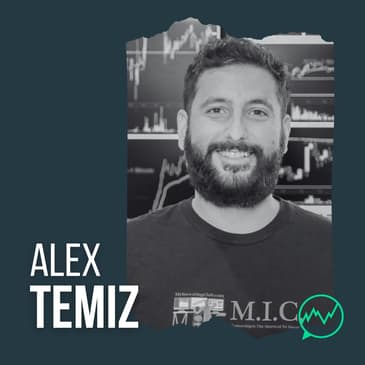
Alex Temiz turned a $2,000 account into over $16 million in trading profits, starting from nothing as a part-time Starbucks barista. In this episode, he breaks down the real journey: the years of losing, how he transitioned from long breakouts to short selling, and the mechanical "guardrails" he used to survive long enough to succeed.
After selling the rims off his car just to fund one last attempt at the markets, Alex discovered his edge in the volatility of momentum exhaustion. Today, his approach is built on extreme transparency and a deep respect for risk management, specifically through his "First Red Day" framework.
In this conversation, Alex pulls back the curtain on his evolution from an aggressive gunslinger to a disciplined professional, sharing the psychological shifts and specific setups that allowed him to scale from four figures to eight figures.
In this episode, we explore:
· How Alex Turned $2,000 into $16M+ in Trading Profits
· His transition from working as a Starbucks barista to full-time trading
· The mechanics of the First Red Day strategy
· Why he ignores his "average" to focus on adding to winning trades
· Using broker-level guardrails to protect yourself from ego-driven losses
· How Alex selects the stocks he shorts
· His advice for traders struggling with the psychological pain of risk
About Alex Temiz:
Alex is a professional short-seller and the co-founder of My Investing Club (MIC). Known for his "First Red Day" setup and high-stakes momentum trading, Alex has documented over $16 million in verified profits. He is a vocal advocate for transparency in the trading industry, frequently sharing live trading recaps to help retail traders develop a process-driven approach to the markets.
Links + Resources:
YouTube: https://www.youtube.com/@AlexTemizMIC
X (Twitter): https://x.com/AT09_Trader
Instagram: https://www.instagram.com/alex_temiz
Sponsor of Chat With Traders Podcast:
Trade The Pool: http://www.tradethepool.com
Time Stamps:
Please note: Exact times will vary depending on current ads.
00:00 How Alex Turned $2,000 into $16M+ Day Trading
06:48 Working as a barista while trading
10:08 Discovering Short Selling and finding his edge
15:13 Developing a healthy approach to trading
20:31 When ego takes over a trade
25:18 Capitalizing on the once in a quarter A plus set up
28:55 Becoming comfortable adding to your winner
33:56 Why adding to losers is adding gasoline to a burning house
37:12 Scaling out of size
42:49 The mechanics of the First Red Day
46:03 Still learning from other traders
52:57 What winning looks like for you now
56:06 Where can you find Alex Temiz
Trading Disclaimer:
Trading in the financial markets involves a risk of loss. Podcast episodes and other content produced by Chat With Traders are for informational or educational purposes only and do not constitute trading or investment recommendations or advice.
Learn more about your ad choices. Visit megaphone.fm/adchoices
[00:00:00] What would your trading look like if capital wasn't the constraint? That's the reality for most traders. It's not skill holding them back, it's size. Trade the pool changes that. Step into the U.S. equity markets with up to $200,000 in buying power without committing your own capital. Full access to stocks and ETFs, long or short. Executed with the precision and freedom serious traders expect. Your performance is measured by one standard, disciplined risk management and consistent execution. Meet that standard and you operate at scale.
[00:00:30] No subscriptions, no ongoing obligations, just a clear path forward. For those ready to trade beyond limitations, this is the next level. Doesn't your portfolio deserve the best? Then join TastyTrade, Investopedia's best platform for options trading, 2026. Trade smarter with advanced charting tools, backtesting, a pre-built strategy selector and more features.
[00:00:52] Join TastyTrade today and earn a double commission rebate up to $3,000 total on your stock and ETF option trades for 30 days. Visit TastyTrade.com slash chat for more info. All applicable regulatory exchange and clearing fees still apply. Options involve risks and are not suitable for all investors. Learn more about TastyTrade promo terms and conditions at TastyTrade.com slash double. Offer expires May 31st, 2026. TastyTrade, Inc. is a registered broker-dealer and member of
[00:01:22] NFA and NFA and SIPC. Trading in the financial markets involves a risk of loss. Podcast episodes and other content produced by Chat with Traders are for informational or educational purposes only and do not constitute trading or investment recommendations or advice.
[00:01:36] I think that all of the greatest traders have to go through some sort of struggle because that struggle will teach you risk management. That struggle will teach you how to be humble. That struggle will teach you how to grade your setups. Without struggle, without failure, you will not know what you're capable of and you will not know what works. For me, I realized that I was a deer in headlights. So anytime a stock would go against me or anytime I would get into trouble, man, I just couldn't click the button. I just couldn't click it. You know what I'm saying?
[00:02:05] So I had to have the broker come in and do it for me. What does that mean? I had to set a max loss auto liquidation. So if my account got to minus $5,000, I wouldn't even have to click the mouse. I would get auto liquidated out. You know, if I would add to my losers consistently, I would set a max size on my account. So let's say it's 10,000 shares. I could not keep adding to a loser and add to a loser over 10,000 shares and balloon my risk.
[00:02:30] So I think it's mandatory as a retail trader to have some sort of loss limits in place because that's like jumping out of a plane and not having a parachute. That's like driving a Ferrari and not having a seatbelt. You know, it's like hopping in the water with sharks and not having a shark cage, right? I mean, you can do it. You're probably going to fucking die. I say screw your average, man. Screw your average. Why? If the stock is going in your favor, I don't care what my average is because the more the stock goes in my favor, the higher my win rate gets on the stock.
[00:03:00] Your house is on fire. Do you think the best way to get your house out of fire is to add more gas? Or do you think you should add water? When a house is on fire, that means your trading is wrong. That means you're wrong on a trade. These idiots are adding gasoline to their fire. They're making their fire larger and larger. And they're like, why the hell is my house burning down faster? Markets, speculation and risk. This is the Chat with Traders podcast.
[00:03:29] Traders, welcome back to another episode of Chat with Traders. I'm your host, Kevin Avery. Now, from time to time, we bring guests back on the show, not to revisit the same conversation, but to understand how they've evolved. In trading, longevity is defined by adaptation, and those who remain consistent over time are often those who have refined not just their strategy, but their way of thinking. Now, today's guest, he's no stranger. Someone who first appeared on Chat with Traders in episode 104.
[00:03:58] At the time, he was very aggressive, a developing trader in your early 20s, navigating the realities of risk, execution, and the challenges that come with finding consistency. Since then, his career has progressed significantly. Alex Temiz is now a professional trader and co-founder of My Investing Club, recognized for his specialization in short-selling low-flow, small-cap momentum stocks.
[00:04:21] His focus has been on identifying moments of momentum exhaustion within highly volatile environments and executing with precision. He has also become known for his emphasis on transparency, including trading in real time and maintaining a structured, process-driven approach to the market. What makes his story particularly compelling is the trajectory.
[00:04:42] He went from working as a Starbucks barista, funding a small personal trading account, to building over $16 million in verified trading profits over the course of his career. What makes this conversation particularly relevant is the contrast between where he started and where he is today. In his earlier appearance, Alex spoke openly about the challenges he faced early in his career, including account drawdowns, difficulty managing risk, and operating with a highly aggressive approach to trading.
[00:05:11] Those experiences played a significant role in shaping the framework he operates within today. Prior to trading, his path was far from conventional. He funded his trading account by selling the rims from his car. We're going to find out if he bought those back. And then he started with just the $2,000 there. The early struggles on the long side of the market ultimately led him to focus now on the short-selling, where he began to really develop his edge. So in this conversation, we're going to focus on evolution.
[00:05:38] We discuss what's changed from his earlier years to now, how his approach to risk has adapted in a market environment characterized by increasingly extended moves in small-cap stocks, and how he currently approaches one of his core setups, the first red day. This discussion centers on process, discipline, and the ongoing adjustments required to remain effective in a constantly changing market. Now with that, here is my conversation with Alex Temiz. Alex, welcome back to Chat with Traders. It's good to be back, man.
[00:06:07] It's crazy because this is the 10-year anniversary, I'm pretty sure, right? Yeah, it's been 10 years. So I want to talk about that evolution. I mean, what was the Alex of 10 years ago? How has Alex evolved in that time? Man, I can't even believe that guy. That guy was a kid. He was a real kid. And, you know, I still consider myself a kid at heart. But just to kind of go back and, you know, I was actually listening to that podcast again. And my voice sounded different.
[00:06:36] I would talk a little bit slower. Maybe I was using some vulgar language from time to time. But it's just amazing how much my trading, my life, and everything around me has changed. You know, back then I was a single guy. Now I'm married. You know, back then I was living in New Jersey with my parents. Now I'm in Miami living with my wife. You know, back then, you know, my biggest day was probably... Actually, that was recorded right before my biggest day, actually.
[00:07:05] So that was recorded right before my first $100,000 day. And now, you know, my biggest day is like eight, nine times that, you know? So it's just crazy how much things have changed. It's good to be back on the show. I appreciate you guys having me back here. Yeah, let's hope the next biggest day is going to be a little bit thereafter from this episode. But thank you so much for coming on. So what stands out the most from now until then? What's changed, do you think, the most in your trading? So great question.
[00:07:35] I think what's changed is not only my understanding and respect of risk, but my transition into more aggressive trading on specific scenarios. Back then, I was like a gunslinger. I understood risk, but I didn't appreciate it and I didn't fear it. Back then, I was being aggressive on any single setup that was available.
[00:08:05] Now, I'm very particular. I'm very selective with how I scale in and how I size up. So that transition from immature, gunslinging child into mature, professional trader, I mean, I think would be one of the biggest things that's changed. Hmm. Yeah, let's go back to the origin story. I mean, a lot of the traders have heard it. So let's just preface with that a little bit when you were working as the barista.
[00:08:34] This is what, 12 years ago now at this point. And you sold the rims off your car to fund that first account, a couple thousand dollars. Confirmed. And your girlfriend had left you at the time. And I heard you say that that was your last try. That $2,000 was your last try. I'm curious, looking back, if VGGL, the ticker you traded that worked out, the first short, if that had gone the other way, what do you think would happen?
[00:09:03] I'm a big Avengers movie guy. Yeah. The biggest things in the Avengers is the multiverse. So there might have been a multiverse where Alex was just back at Starbucks. You know, I always thought that when I was, you know, at Starbucks that I would eventually go off to own like five or 10 or 15 different Starbuckses. Because I've heard from a friend that some guy owned like 15 Dunkin' Donutses and he became a billionaire.
[00:09:29] And so I was like, you know, worst case scenario, you know, maybe I'll just kind of go on this Starbucks path forever. And, you know, maybe in that alternate universe, if VGGL didn't kind of go down that day, that's where I would have been. Who knows? Would it have turned out to be a regional manager? Would it have turned out to be a senior manager? Who knows? Maybe my life would have been better, less stressed. But what a danger. Hold on. You were destined for greatness. I mean, that's what I was thinking when I heard that. Because you had a $2,000 account.
[00:09:58] You made $1,000 on that short. That was a heavy position at that time. And like you said, maybe you didn't respect the risk at that time or you didn't have a fear for it back then. But it favored you in that moment. Yeah. It's crazy. It's crazy because, you know, I started off trading on the long side because I was taught buy the breakout. You know, buy the breakout is the beginner strategy that's easy to understand.
[00:10:26] And stock breaks out, you buy it, and it goes higher. What we have to understand about buying the breakout is buying the breakout only works in a certain market environment. Right now, as we're recording this, it's March 31st. You know, stock market is down, you know, 10% on the year. Oil is up, you know, massive to $105 a barrel. And right now, if you try buying the breakout on anything that's not oil, you're dead, you know.
[00:10:54] But had you tried to buy the breakout four months ago, you'd be the best trader in the world. So what I didn't know back then is I didn't know that, you know, there are certain things that only work based on the appropriate market cycle, you know. So that's kind of what I think is super important. And then what I ended up doing is every time I would buy a breakout, it would just crash down. I was like, dude, how the hell am I ever going to make money doing this? And eventually, I discovered something called short selling, which is making money when the stock goes down.
[00:11:24] So, you know, when you open up your brokerage platform, there's a buy button and there's a short button. I was like, dude, instead of hitting buy, if I hit short, you know, I'm going to get rich. And that's kind of where that first trade happened on VGGL. I shorted 2,000 shares at $4 a share, made $1,000. And from there, I was hooked. That's what changed everything. Changed everything. I mean, was that, you think, one of the most significant aha moments in your trading, just realizing, I no longer have to chase breakouts.
[00:11:52] I can just click the sell button and short these things. And from there, that's the opportunity that you seek. I was like, dude, this thing is going to go down anyway. Why don't I just hit the other button and see what happens, right? And everything I buy, the same second, dude, the same second it crashes, right? Because I was buying in all the wrong spots. You know, most of the time, you know, when you're buying the breakout in the wrong type of market, that's liquidity for sellers, right? And I didn't know that. And I actually remember because it was funny at the time.
[00:12:19] You know, I was still obviously living with my parents, brother, this, that. And, you know, I remember and I had that $1,000 trade. And I remember leaving my bedroom and walking to my brother's room, who was about two years younger than me. And he was like flipping sneakers, right? So he was like flipping sneakers. And, you know, he was maybe making, I don't know, 50 bucks a sneaker. I don't know, whatever it was back then. And I was like, Alan, like, I just made $1,000. He's like, what?
[00:12:47] I was like, dude, I just made $1,000. And he just couldn't compute it because, like, dude, I'm Starbucks. He's selling sneakers like the most money. You know, it would take us months to make $1,000, you know, and I made it in a day. So I would say that was definitely one of the more significant trades that I did simply because it gave me hope. It gave me hope that, wait a second, did I just discover something that is going to change my life? You know, back then, my goal was very simple. I want to make $100,000 a year.
[00:13:17] I thought that $100,000 a year was rich. These days, $100,000 a year, you're still poor. It's crazy. But, you know, that's kind of what I was shooting for and aiming for. And, you know, eventually it turned to $100,000 days. It turned into, you know, $100,000 losses as well. But the reality is that that moment of VGGL, it's crazy because the stock is delisted. You know, I can't even like, I can't, I tried to. Can't reminisce. Can't go look at it. Where did I get in? Where did I get out? Yeah.
[00:13:47] Yeah. I mean, look, I tried to frame it one day, like that day and sometime in 2014. That's the most important trade for you. I mean, it really is. Yeah. Forget the $100,000 trades wouldn't have happened without that, right? So that trade was so important because it gave you that hope. Now, you mentioned VGGL is delisted now.
[00:14:41] I'm curious. Maybe more. But just a rough math in my head is like at least 20% of the stocks that I trade are disappeared forever. You know? Just delisted gone. So do you think that, I mean, you paid that early tuition early in your journey. Do you think most traders need that early on? They learn in those drawdowns. Do they have to experience the losses?
[00:15:05] Or can they just learn without crashing the plane, as EDU trades would say? I love that analogy. He said, I don't have to crash the plane to learn how to be a pilot. Do you have to crash the plane? Do you need those losses? What do you think? 100%. I've not met a single successful trader that has not struggled at the start. You know, the best example is I actually recently did a podcast with Lance Breitstein, who's made $100 million. He's in the Market Wizards book.
[00:15:34] And he said he was the worst trader in the world, so much so that he was about to look for another job. His firm was sick and tired of his losses, and he was unable to really find any type of success for a couple years. That guy went on to be a market wizard making $100 million. So I think that all of the greatest traders have to go through some sort of struggle, because that struggle will teach you risk management.
[00:16:03] That struggle will teach you how to be humble. That struggle will teach you how to grade your setups. Without struggle, without failure, you will not know what you're capable of, and you will not know what works. You know, if you just started trading and you had a little bit of beginner's luck, eventually that beginner's luck is going to run out, whether it be market cycles, whether it be change in conditions. But the fundamentals of risk management, the fundamentals of grading your setups,
[00:16:27] the fundamentals of fundamental analysis, you know, will give you that foundation. And what you have to understand about trading is the same thing as a house. The foundation is the most important part. Without a strong foundation, you cannot build a skyscraper. You know, as soon as you start building on a shitty foundation, your building's going to collapse.
[00:16:49] You know, you said over the years, too, you've developed more of a healthy risk, just a healthy, I guess, approach towards your trading and towards risk. Unless you just respect it more. What happened along the way where it said, you know, I got to start having more of a healthy, respectful attitude towards this risk?
[00:17:12] Yeah, I mean, I think that as a trader, the question becomes how much pain do you want to take before you learn your lesson? You know, and me being a stubborn kid, it took me a while to learn these lessons. And it's like, how many times do you want to lose more than your risk? How many times do you want to get yourself out of a hole?
[00:17:36] How many times do you want to struggle and suffer and, you know, be upset with yourself until you finally, you know, learn your lesson? And for me, I realized that I was a deer in headlights. So anytime a stock would go against me or anytime I would get into trouble, man, I just couldn't click the button. I just couldn't click it. You know what I'm saying? So I had to have the broker come in and do it for me. What does that mean? I had to set a max loss auto liquidation.
[00:18:02] So if my account got to minus $5,000, I wouldn't even have to click the mouse. I would get auto liquidated out. You know, if I would add to my losers consistently, I would set a max size on my account. So let's say it's 10,000 shares. I could not keep adding to a loser and add to a loser over 10,000 shares and balloon my risk. So adding these guardrails that the broker, the technology helped me was able to kind of scale my trading.
[00:18:30] So something to keep in mind is when we are trading, you have to understand that there's retail traders like us. Then there's the professional Wall Street traders. A professional Wall Street trader has someone called a risk manager. A risk manager's full-time job is to monitor your trades. And if you're getting a little bit sloppy, tap you on the shoulders. What's your plan? What are you doing here? As retail traders, we don't have that.
[00:18:56] So we need to have our retail brokers act as our risk managers to protect ourselves from ourselves, you know? Wow. Yeah, just the max loss on the account, the broker liquidates to you. Man, that resonates for me too, something I applied. Do you think most traders need something like that? Because we oftentimes get in our own way, right? I mean, that's what you hear on the trading journey. It's not necessarily the edge. It's not necessarily the strategy. The edge is the discipline, right?
[00:19:25] To stick to it, and oftentimes we don't stick to it. Do you think that's a rule that most should apply? I think every trader should do it. I think 100% of traders should do it. Because the reality is that in the trading game, in the trading business, at the end of the day, any idiot can make money in the market. But the people that last a long time are the ones that keep that money.
[00:19:47] And I feel like a lot of traders, you know, the main thing that always happens is like, you know, they get into a hot streak and they're making a little bit of money. And as soon as the hot streak stops and they're faced with adversity with any type of stock, they keep consistently adding to a loser and adding to a loser and adding to a loser so that they don't stop their hot streak. And let's say their hot streak yielded to $10,000 in profits. They end up blowing up 50K.
[00:20:16] They end up blowing up way more than what their streak was. So a very basic rule that I give for setting risk parameters is this. Your max loss auto liquidation should be no more than two days worth of your trading. What does that mean? If you make $100 a day trading, your max loss auto liquidation should be $200. That way, on your worst possible day, it takes two days to make it back. What people do is they make $100 a day and they set their max loss to 5K. Takes them freaking so long to make it back.
[00:20:46] It makes no sense. So that's what I would first start off by doing is set your max loss auto liquidation in no more than two days worth of your work. Because the reality is how many times as traders, myself included, we said, all right, my max risk is $500. If it goes to $500, I'm going to stop out. It goes to $500, you don't stop out. Then it goes to $700 and you're like, if it goes just back to $500, I'll get out. Then it goes to $1,000 and you're like, please go to $700. I'll get out. I'll eat loss. Then it goes to $2,000, $3,000, $4,000.
[00:21:15] You blow up your entire month and you're like, what the hell did I just do? But if you just had that broker kick in at $500, you would have been so much calmer. You would have been so much more chill and you would have probably made back that loss the next day. So I think it's mandatory as a retail trader to have some sort of loss limits in place because that's like jumping out of a plane and not having a parachute. That's like driving a Ferrari and not having a seatbelt.
[00:21:42] It's like hopping in the water with sharks and not having a shark cage, right? I mean, you can do it. You're probably going to fucking die. I love those analogies. Longevity is what you're speaking on. I mean, and you've lasted here for a long time. And over the years, I'm sure you've seen many, many traders fall by the wayside and even probably consistent traders, which is why I want to touch on this risk management portion.
[00:22:08] How many traders have you seen that are really good traders? But they apply then too much risk on that one trade or on one day or one week or one month even. They're not zoomed out enough to the point where it just breaks your heart. You say, man, this is a great trader, but his ego took over. He went way too heavy on this trade.
[00:22:28] And then from there, I'd also want to transition to where you have an account size that I've heard you say you just keep right around 50K maybe for that risk management so you don't oversize, over leverage on setups. What are your thoughts on that? Are you ready to get serious about options trading? Then join TastyTrade, Investopedia's best platform for options trading, 2026, stocks, options, futures, and more. TastyTrade has everything you trade all in one platform.
[00:22:57] Get low commissions, including a $10 cap per leg on options trades so you can keep more of what you earn. TastyTrade is packed with advanced charting tools, backtesting, a pre-built strategy selector, and more features to help you trade smarter. Manage your positions with speed and precision using Active Trader Mode, one-click trading, and smart order tracking. Plus, TastyTrade's stellar trade desk team offers live support during trading hours if you need it.
[00:23:21] Join TastyTrade today and earn a double commission rebate, up to $3,000 total on your stock and ETF option trades for 30 days. Visit tastytrade.com slash chat for more info. All applicable regulatory exchange and clearing fees still apply. Options involves risk and are not suitable for all investors. Learn more about TastyTrade promo terms and conditions at tastytrade.com slash double. Offer expires May 31st, 2026. TastyTrade Incorporated is a registered broker, dealer, and member of FINRA, NFA, and SIPC.
[00:23:49] Ever watch a stock rip and think, I could have nailed that if I had real capital? The truth is, many capable traders never reach their potential. Not due to lack of skill, but lack of scale. Trade the Pool was built to solve exactly that. A firm designed for serious individuals who want access to the U.S. equity markets with meaningful buying power, up to $200,000 without committing their own capital. Get access to virtually every stock and ETF.
[00:24:15] Go long or short freely with the flexibility professional traders expect. You're evaluated on one thing, your ability to manage risk and execute with consistency. Meet the standard and you trade at scale. No subscriptions, no ongoing commitments. Whether you're still refining your strategy, a trader with experience who hasn't yet broken through, or a seasoned professional simply looking for more capital, Trade the Pool is built to meet you where you are and take you that next step further.
[00:24:44] The markets have evolved, access has evolved. Now, so has the way traders operate within them. Trade the Pool. Ready to soundtrack your summer? With Red Bull Summer All Day Play, you choose a playlist that fits your summer vibe the best. Are you a festival fanatic, a deep end DJ, a road dog, or a trail mixer? Just add a song to your chosen playlist and put your summer on track. Red Bull Summer All Day Play. Red Bull gives you wings.
[00:25:13] Visit redbull.com slash bright summer ahead to learn more. See you this summer. Right, so two things. Let's start with number one. So number one is, how many traders have I seen that just have the talent but don't have the risk management? Man, I knew a guy, and this guy would make consistently, like over 20 days, he'd be green every day. And over those 20 days, he'd make $100K. And then that one red day comes, $120K minus.
[00:25:39] And just that same cycle over and over and over and over and over again, needless to say, that person's not around anymore. He had the talent for making $100K in 20 days, but every time he had one possible red day, gone. And also, something to keep in mind is there's those people that risk too much, and there's the people that are the complete opposite of the spectrum, that are scared to lose $20. I had a friend that sports bets like $300 a day.
[00:26:06] But when he gets into trading, he's betting $20 on a loss, and he's freaking out. Like, what the hell are you doing? You're gambling more on freaking sports betting, but a tenth of it on trading, you're freaking out. So there has to be kind of like a middle ground of, you know, you have to be not only accepting of risk, but you can't be scared of it either. You know, some people are just deathly afraid of losing $20. And if that's the case, you know, maybe trading is not for you. So I've seen both ends of the spectrum, you know?
[00:26:34] Well, you started out with the $2,000 account, right? And then you've grown it and grown it and grown it. But, I mean, how can you talk to the person out there who's listening who is scared of that risk? Like, they have a smaller account, and they don't know how to size up to that next level where you kind of were able to embrace that risk. How can that trader embrace that risk? Yeah, so I think it's really important. It's number one is if you do not know the grade of your setup, you have not earned the ability to size up yet.
[00:27:04] And it's very, very simple to understand because the reality is whenever someone wants to get into trading, they want to start sizing up immediately, right? It's like, you know, you start trading, you see all these, you know, Instagram videos, these YouTube videos, the cars, the watches, this, that. And then, you know, you're trying to replicate that with a $1,000 account. It's going to be very, very difficult. And what you have to remember is maybe it might be a good idea to kind of, you know, share a little bit about me.
[00:27:32] It's my first year trading, I lost money. My second year, I broke even when I discovered short selling. My third year, I started to make like $100 a day, right? So by my like fourth years when I started to really excel in trading. So what I think people have to understand is even making a very small $50 to $100 a day is not, the point of that is not to change your life. The point of that is to prove that you understand the market and understand, you know, very simple market conditions.
[00:28:01] Because at the end of the day, you could always add a zero at the end of your share size, right? But to kind of backtrack is I think people need to realize that size is reserved for the best setups only, right? It's like what is like the perfect opportunity, right? Perfect opportunities don't happen, you know, every single day, every single week. Perfect opportunities happen once or twice a year.
[00:28:24] You know, some of the most recent examples I can think of is during April of last year when President Trump announced a 90-day pause, market ripped up. That's a once in a decade opportunity, you know? Or, you know, even more recently, Beyond Meat when it went from like $0.50 to like $8 back down to like $3. You know, that was a once a year type of opportunity, you know? So there's always going to be these, or even, you know, the GameStop, the AMCs, and all these other crazy runners, you know, once in a couple year opportunities.
[00:28:53] So you have to tell yourself, is the opportunity that I'm trading similar to that? And if the answer is yes, that's when you get aggressive. If the answer is no, you just sit around and scalp around. So for me, every day that I show up, I'm not looking to make $100,000, although I would like to. You know, if the opportunity is not there, then I'm not going to be aggressive. So I always just try to show up and just ask, like, is this a day to size up based on a high probability setup?
[00:29:21] Or is this a day I'm sizing up just because I feel like it? And if it's just because I feel like it, God bless, I'm probably dead for the day, you know? Right. So what do you think about that saying then that 90% of your profits are made on 10% of the trades? Do you think that's true? It's accurate for me. Okay. For most traders, I know, you know, like the biggest trades I had, you know, you know, the multi six figure days. Those are the days that, you know, end up creating my big P&Ls.
[00:29:51] But every day that I'm showing up to the market, I'm making five or 10 grand scalping. You know, I'm adding some extra P&L to my bottom line. I'm staying in tune with the market because the reality is that, you know, if you just show up for those big days, call it four times a year, once a quarter to make the math easy. If you show up for those big days and you screw it up, oh man, you're dead. You're dead. So by being in tune with the market and by trading every single day, I am seeing, all right, what is the sentiment of the market? What is working?
[00:30:20] What is not working? Because if I'm blindly not looking at the market, I won't know that maybe the stocks that are fading in this quarter are stocks that are pushing for two days and then on the third day they're failing. If that's what I've been seeing and monitoring in the market, well, if I just don't do that and I come back and I say, oh, this stock is running on day two, I might be dead. So the day-to-day trades are to kind of keep you in tune with the market, in my opinion, as you wait for those big Super Bowl-style opportunities that come once a quarter, you know?
[00:30:48] And just recently in this last quarter, we had gold, silver, and oil, you know? I love that. Yeah, I mean, that's excellent. Excellent. So do you still keep your kind of – your back against the wall, if you will, with the $35,000 or $50,000 that you have in the account? Where are you with that now? And do you – and when those opportunities present themselves, that once a quarter opportunity, do you, let's say, even wire in money at that point and say, hey, I'm hammering this.
[00:31:18] Let's put the risk on at this point. Yeah, great question. So when I first started trading, you know, I would use, you know, more of like – because you have to have like – because PDT is going to go away sometime this year. But, you know, the PDT rule is $25,000 and you need to have at least like $30,000 in your account for like a little bit of a buffer. So when I finally got over that hump and had enough to, you know, fund my account with that, you know, I'll keep my account around $35,000, which gave me like a $10,000 buffer. And every time that my account grew to $50,000, I would wire out $15,000.
[00:31:48] I put that in my bank account. Put that in my bank account. Put that in my bank account. You know, now, you know, it's kind of similar to the thing. You know, I've been kind of keeping it around like $50,000, $60,000. Every time I get to $100,000, I wire it out. But what I do is on those very, very big opportunities, I definitely wire in. Now, this is a more advanced type of thing. I do not suggest that most traders do this because most traders do not know what the proper, you know, high probability setups are.
[00:32:12] But yeah, I have no problem, you know, wiring into my account, taking advantage of that opportunity, and then wiring back out. Because the reality is that for 90% of the year, I don't really need a big account. You know, I just need a big account for those 10% of the setups. And when those 10% of the setups come, I have no problem, you know, wiring in more aggressively into my account to give me that buying power that I need to capitalize. But for new traders, I mean, that's very, very difficult to understand.
[00:32:40] I do not suggest that unless you've been trading for a while and know exactly, exactly what your best setups are. Because otherwise, you're going to balloon your losses in my opinion. This is what you're known for and why you're a legend. You just, you know the A-plus setup. You know how to really just lean into it and take advantage of it. And I heard you even recently say you think newer traders should, I mean, they should get out of that habit of adding to losers and instead adding to winners.
[00:33:07] Now, it's challenging emotionally from what I heard because what happens is, you know, you add to the winner. Well, now your average is coming down. So the traders have a hard time getting comfortable with that. How can traders become comfortable adding to their winners? Yeah, so this is, I have a kind of a controversial take on this. And, you know, this is just kind of the way that I think about it is, you know, I say screw your average, man. Screw your average. Why?
[00:33:32] If the stock is going in your favor, I don't care what my average is because the more the stock goes in my favor, the higher my win rate gets on the stock. Let me give you an example. Let's say I'm going short a stock, meaning I want the stock to go down and I'll make money. Well, if a stock has a death candle, that signals a change in trend. Maybe my win rate on the setup goes from 50% to 65%. And let's say after that, it breaks VWAP, right?
[00:34:01] Then my win rate goes from 65% to 75%. And then after it breaks VWAP, it breaks the low of the day. Then my win rate goes from 75% to probably 85% or 90%. So at that point, when we have a death candle, a break of VWAP and a break of low of the day, the win rate gets so aggressively higher for the stock to go down that I should just be focused on adding to my winner because the win rate is going to be so dramatically higher versus then adding to a loser.
[00:34:28] So everyone's always afraid about having this perfect average, the perfect average, the perfect average. Perfect average doesn't matter if the stock is going against you, right? But if the stock is going in your favor and you are being proven right, it is your job as a trader to get more aggressive when you are proven right versus more aggressive when you're proven wrong. Here's an analogy. Your house is on fire. Do you think the best way to get your house out of fire is to add more fire, add more gas?
[00:34:56] Or do you think you should add water? When a house is on fire, that means your trading is wrong. That means you're wrong on a trade. These idiots are adding gasoline to their fire. They're making their fire larger and larger. And they're like, why the hell is my house burning down faster? I was like, what the hell? Again, that takes you a while to understand. But that's the way that you have to think about it is when you're in a losing trade, your house is on fire. When you're adding to your loser when the house is on fire, you're adding gas.
[00:35:25] The house is going to burn down faster. What you should do is get the hell out of that house as fast as possible and don't look back. You know? That's so good. Screw the average. What you're essentially saying is focus on making money instead of trying to be right, you know, with the perfect average on the ticker.
[00:35:46] If the stock is going in your favor, if your plan is getting proved correct, what people end up doing is when they are proven correct and it's going in their favor, they take the profit. When they are wrong and it's going against them, they're getting larger. It should be the inverse. As the stock is going against you, get out. As the stock is going for you, get bigger. You know, it's like you must bet bigger when you are proven correct.
[00:36:16] So, again, let's say that same example, the stock reclaimed the VWAP. It reclaimed low of the day. It went back to the high of the day. Whatever it did. I mean, trading is not perfect. You're not going to win every single time. You're not going to win on every single trade. But at least you gave yourself the best possible opportunity to get in larger on the setup. But, you know, I'm trying to think of one of the most recent examples that we've seen. I mean, you know, silver, oil and gold have been kind of crazy, right?
[00:36:43] It's like if you remember when oil, I think it was about two or three weeks ago, when oil had that big, big, big gap up and it started to sell off. I think it gapped up to like 100 something a barrel and just starts to slowly sell off, slowly sell off, slowly sell off. Right. And then Trump came out with news that, you know, the war was over. It was BS, but the war was over. Oil collapsed 10 percent more. So when you're being proven right, think about this.
[00:37:10] When you're shorting oil like that and your thesis is oil is going to fade, it's going to come down. And the news of Trump comes out that, you know, the war is over and oil collapses. Does it make more sense to exit your position there or to get an even more aggressive? Because now you have a catalyst to back you up. What most traders do is when they see that backup, when they see that they are being proven correct, they're like, oh, cool. You know, I made a little bit of money.
[00:37:38] But no, when you're proven correct, get in bigger, you know, especially if the setup warrants it. And that's the thing that I think is super, super, super slept on is people love adding to their losers. They love scalping out of their winners. And they wonder, why the hell am I making money? Because every time my house is burning down, I'm adding gas to it. I mean, it's very logical. If you think about it in – I always like to teach with analogies because analogies help them be real, you know?
[00:38:07] So I have a question regarding that. I got a lot. But this one specifically, because I've seen some respectable traders, you know, they size into their positions without – they break up their full position, let's say. So is that adding or scaling? For example, if I plan, you know, 1,000 shares short on this ticker, maybe I start with 200 and size into it.
[00:38:31] Is there an appropriate way to put fuel on your house or is it all fuel and it's just – you show up? No, no, great. I think that's a fantastic question and it's going to be good that we clear this off. So, okay. So I'm going to be talking just on the short buy side of the market because that's kind of where my niche is, right? So everything that I say, if you're long, do the damn opposite. So, okay. So let's say I'm looking to short a stock, right?
[00:38:56] I have a rule and my rule is if a stock is above VWAP, the volume-weighted average price, I am not allowed to use more than 30% of my max size. Why? It's because I don't want to add to a loser, right? So let's say my max size on the setup, again, for math, is 1,000 shares, right? So I want to go max size on a setup that has – it's going to be 1,000 shares.
[00:39:21] If the stock is above VWAP going against me, 30% is the max size that I'm going to use. So that would be 300 shares. So if it's above VWAP, I will not be allowed to use more than 300 shares. Now, as each time I get a confirmation signal, right, a signal that I am being proven right, I'll add to my winner. What does that mean?
[00:39:46] If the stock then breaks VWAP, I will get to 50% of my size. If the stock then breaks low of the day, I'll get to 75% of my size. And then what I like to do is I always like to take a little bit of profit off the table because whenever I take a little bit of profit off the table, it helps me be patient. And in case the stock bounces, I could repurpose some of those profits as a reshort.
[00:40:14] So for me, every time I get a signal proving me right, that's when I add. So if you're a loan buyer's trader, if it reclaims VWAP, you add to your winner. If it reclaims the high of the day, you add to your winner. If it reclaims the pre-market high of the day, you add to your winner. So every time that you're getting proven right on any type of setup, any type of signal, any type of something that says, you know what, Kevin?
[00:40:39] My thought process was I'm looking to short this stock and it just did everything that I want. It did everything I want and that's when I'm going to get aggressive. So I think that's super, super key. And I think that's super, super valuable for most people as well as understand you're not just sizing up. Just because you feel like it. I mean, if I size up just because I felt like it, man, I mean, I don't know. I mean, I feel like it every day, man. I'm feeling hot, you know?
[00:41:04] But the reality is that, you know, at the end of the day, you know, I just want to make sure that, you know, whenever there's a signal, whenever there's a reason, whenever there is a proven fact in the chart emphasizing my idea, go for it, baby. Go for it. Let's say that trade where you're taking 30% max of the share size.
[00:41:31] Let's say it goes against you, you know, it invalidates. Are you taking one just hard stop on one exit or are you breaking that exit up into multiple positions? How do you go about that? Well, for me, what I've realized is this. It is a lot easier to stop out of your position when you have 30% of your size on than it is 50% or 1,000%. So back in the day, before I had this rule in place, I would stop out of half.
[00:42:01] And then if it keeps going against me, I stop out of the other half. But now with 30% of my size, man, I could close my eyes and stop out. It doesn't – it's like a paper cut rather than a dagger, you know? I love it. Great analogy. So do you think for – I know we're talking sizing. And you talked about grading your setups, which I think is huge. But for the newer trader, I mean, they have to essentially throw darts, you know, before they figure out, like, where's my edge? Where does it lie?
[00:42:31] What's my setup? Which we're going to dive into yours. So do you think for the newer trader that they should be sizing in and out of trades? Or do you think they should keep their sizing fairly consistent until they do know how to grade, like you're saying? I think in this day and age, there's so many different tools out there, whether it be, you know, these trading journals that are, you know, $20 a month. But even if you don't have $20 a month, man, AI is incredible.
[00:42:57] What you should do is you should take your trades, upload them into AI, and just tag them. Like, hey, this is a trade that I didn't do right on. This is what I'm making money on. I learned – so obviously AI didn't exist when, you know, I was, you know, around. But what I would do is I would upload my trades into TradingView, TradingView, whatever it is. And I learned so many things about myself. Here's what I learned. I learned that I make the most amount of money on stocks $2 to $10.
[00:43:27] I learned that I make the most amount of my money from 9.30 to 10.30. So if I learned that I make most amount of my money from $2 to $10, I don't trade under $2. I don't really trade over $10 unless it's a very big opportunity. If I learned that I make most of my money between 9.30 and 10.30, I don't trade before 9.30. I don't trade after 10.30. I learned that I lose the most amount of money on Mondays. Why do I lose the most amount of money on Mondays?
[00:43:53] I'm so excited over the weekend to trade that I get overeager on Mondays. So I try to size down on Mondays. You know, I learned that I have a 75% win rate. So anytime my win rate is under 75%, that maybe I should start slowing down. What the hell's going on, Alex? Something's changing, you know? I learned that if I don't get enough sleep during the night, I don't perform well. I learned that if I'm hungover when I'm trading, I don't trade well. I learned that if I fight with my girl or fight with my friends, I don't trade well.
[00:44:20] So all these little things that, you know, may seem little in the moment told me exactly what I need to know. I don't trade before 9.30. I don't trade after 10.30 anymore. You know, I don't trade as aggressively on Mondays. You know, I walk away. If I have a fight with my girl, if I don't get enough sleep, I'm sizing down. So that took me years and years and years of my data to track.
[00:44:41] And the reality is that, you know, the only way you could find what works for you is you have to track your own stats because every single person is a different type of trader, man. We are all different traders. We have all different things that we work on. We have all different things that we struggle with. And the reality is my trading mistakes are not going to be your trading mistakes. You know, maybe for me, the fact that, you know, you know, I actually know it's going to sound crazy.
[00:45:09] I know a trader that trades way better when he's drunk. Why? He's trading through instinct. He's been a 20-year-old trader. Do you trade with him every day? Yeah. He's bound. You know, he's bound. I'll throw him under the bus just for education. But, you know, I can't tell him that. But he's a way better trader when he's drunk because he's not thinking. He's just reacting. It's like I'll give you an example.
[00:45:35] The first time you started learning how to drive a car, you know, you'd be like, am I in the lanes? Did I pull my signal up? Did I turn left and right four seconds at the stop sign? Now when you get in the car, you don't even think. You just do. You just do. So that's the way it is in trading is after you get good enough, you stop thinking about it. It's intuition, right? It becomes intuition, which I was going to ask you too. Do you still have to really track and journal these days like you did back then? Or it's just intuition?
[00:46:05] Like, you know, you just know. You just know when to size up, size down, not to trade on, you know, size down on Mondays, all of them. The honest truth is I should be tracking my stats more. You know, but after 12 years and $16 million, I've gotten a little bit lazy. But I definitely because now I know. Now I know. I mean, it's not really going to change from here. You know, maybe the little nuances might change a little bit, you know. But the reality is that I know everything about my personal trading. I know where I'm an idiot. I know where I excel.
[00:46:35] And yeah. So that's kind of what I think. All new traders, no matter what, no matter what, have to track because you don't know. You don't know what is working for you. I could say that, you know, my best setups are the first red day. Turns out maybe you suck at first red days, but you're better at buying a VWAP reclaim, whatever it is. If you don't know that, then you're going to be sizing up on all the wrong setups, you know? Yeah. Let's talk about that core edge.
[00:47:03] I mean, that you've traded consistently over the years, that first red day. I mean, what has – why has that worked so well consistently over the years, that first red day that you continue to trade? This is Kevin. We hope you're enjoying this episode so far. If you are, take a second to leave a comment. We read them all and truly care about what you think. And if you haven't yet subscribed to our email list, visit chatwithtraders.com and click subscribe so we can keep you posted on information that matters.
[00:47:31] Now, back to the chat with our guest. As long as human greed and human fear and human emotions don't change, the patterns will not change. What does that mean? The reason why a first red day works so well is because it capitalizes on the human greed. Stock goes from $2 to $5, then $5 to $10, and $10 to $20, and $20 to $40, $40 to $60. Like, baby, it's going to $100, right?
[00:47:58] And then all of a sudden, the first day that it doesn't continue to extend is the day that it tops out because all of these inexperienced longs keep averaging down to their loser, whereas the smart money is selling into their liquidity. You know? Absolutely. Now, with some of these plays I've heard you say early on, you may have those, like the 50% runners. Like, let's take the first example. You saw a stock that goes from $2 to $5, and that would be a significant move, what, 10 years ago.
[00:48:27] But then it kind of transitioned into you getting $200, $300, $400, $500, that greed you're talking about just taken over the years. And so how do you identify, okay, this is the first red day, and they're not just kind of trapping you and sending it up to the next 1,000%? Yeah. I mean, look, the reason why the first red day works is it's the first day that it goes red. You cannot anticipate the move.
[00:48:55] You have to wait for it to go red and then attack it. You know? So that's kind of what helps build, you know, this patience aspect is, for example, one of the biggest first red days for me this year was on gold. I made around $200,000 on gold, and I think I have the live trading video on YouTube. So every day I trade live, and then I post those replays on YouTube.
[00:49:18] But the reason why gold worked out is because it was a multi-day runner that pushed and pushed and pushed, and then finally gapped up towards $5,500-ish, where GLD was around $505. And then when it gapped up and finally sold off, I mean, that was the top forever. And I'm referencing the first red day on January 29, 2026. That's the top for a very, very long time.
[00:49:47] It had on January 27, January 28, gapped up, gapped up, third day gap up, went red, and it was gone forever. You know? And it's just, to me, the trade got initiated not on the gap up. The gap up gave me some, I would say the gap up gave me kind of like, it's like a shark that has blood in the water.
[00:50:16] You know, the shark is starting to look around. You know, he smells a little bit of blood. You know, he sees what's about to happen. And then when it goes red, it's attack. You know? Love it. So you've been around so many, you know, high-level traders, including the time you had at SMB Capital. From the best traders that you've seen, what do you really think separates them from everybody else? Brother, I love this question. And I just want to give you some props. These are some amazing questions.
[00:50:44] So, man, I've been fortunate enough to know seven, eight, and nine-figure traders. And I think the one thing that they have in common is the love of the game, meaning trading is their passion. It's something that they want to keep learning about. It's something that, you know, gets them excited.
[00:51:14] And also, willingness to keep learning. So I found that the traders that make the most amount of money don't just say, hey, I'm Alex. I made $16 million. I don't need to learn anything anymore. I don't need to do anything. Because what I understand is that every time I place a trade, there's someone else on the other side of the trade. Every time you place a trade, you're trading against me, right?
[00:51:40] So what has been really, really important to me is I've always been willing to learn from other people. You know, someone like Lance that's made, you know, five times more money than me, I'm watching his YouTube videos every single day. You know, I'm reaching out to him via text. I'm asking him questions. You know, I'm trying to learn from someone like him. Or another guy, Phil, who's in the Market Wizards book. I talk to him very often. You know, Jack Kellogg and all these other people as well.
[00:52:06] I'm always willing to learn from traders that have, you know, made more than me. Because the reality is I have still so much to learn. And I often feel like, you know, maybe inexperienced traders or traders that have too much of an ego do not last because they think they know it all. And the reality is the moment that you think you know it all, you actually know nothing.
[00:52:27] So I think the most elite traders are not only obsessed with the game, but also willing to learn and also willing to drop their ego aside, remain humble, and, you know, just continue to improve day to day. You know, it's very funny because even to this day, no matter how much money I've made, I'm still watching trading videos. I am still watching trading podcasts.
[00:52:54] I am still watching anything that has to do with trading because I'm looking for that next edge that I can learn from someone else. Oh, that's so amazing. You know, that really is a consistent theme I've heard since doing these interviews is passion. And that was my next question was that I've watched so many of your interviews, and what I have seen that stands out to me is the passion. A lot of traders approach this, like you said, thinking that there's some kind of a finish line where they no longer have to learn.
[00:53:23] Essentially, they get complacent. They get comfortable. But then conversation I had with EDU, he said, as soon as you start getting comfortable, you know, that's when you're not going to grow. You have to always kind of be uncomfortable because that's where you learn to grow. So I thought that was really fascinating. And you can tell the passion that you have and just constantly wanting to improve yourself. That's what it sounds like. It just elevates you to the next level, and it's a common theme.
[00:53:51] It's like the bloodstream, essentially, of your trading journey is just having that passion to take it to the next level. So that's excellent. Thank you so much for sharing that. A hundred percent. And that's the reality is like the moment that you think you're not at all, you're an idiot. Seriously. You know, it's like think about how much I'm still learning. Think about how much I've made and how much I'm still learning. And, you know, it's funny because, like I said, people are trading on the other side of the screen of me.
[00:54:20] So you got to think, I mean, I want those people to be as uneducated as possible, as stupid as possible, as dumb as possible. Because at the end of the day, you know, the less work that they put in, the better, you know? Yeah. Yeah. Do you think that traders, they focus too much on making money rather than the money part being a byproduct of just really good trading? And they don't focus enough on, you know, compounding the money.
[00:54:48] Because I've heard that you've kind of transitioned now into generating, taking the trading profits and allocating them more into long-term investments to compound wealth. So is that something you're still focused on right now? Yeah, definitely. I mean, any extra capital that I make, I try to invest in elsewhere because the reality is, like, I say trading will make you rich, but investing will make you wealthy.
[00:55:11] So my goal is to generate income through trading and take that income that I generate through trading and then invest it into longer-term assets. And, you know, that's actually funny because yesterday the market was down a ton. And I ended up buying a ton of stocks yesterday for long-term investments, and today the market rebounded, you know, almost like 2%, you know? Incredible.
[00:55:34] So for Alex, for anyone that's listening right now, earlier in their journey, maybe struggling, questioning if they can really make it, maybe they're about to sell the rims off their car. What would you tell them that you're really mad that would make a difference for them? What piece of advice do you have for them? Yeah, I mean, the question is how bad do you want it, right? If you say you want it, but you're not willing to put in the work, I mean, it's not worth it.
[00:56:01] It's not just buy an S&P 500 index and call it a date. But the reality is that, you know, you have to love the game. You have to be obsessed with it. And I don't know why anyone wouldn't be obsessed with changing their life. I don't know why anyone wouldn't be obsessed with freedom. I don't know why anyone wouldn't be obsessed that you could make more money than a doctor, lawyer, engineer combined in one day and change your family's life. So that to me is a very easy obsession. You know, it's really hard for me to give up chocolate cake and ice cream.
[00:56:30] You know, it's like you know what you have to do. You know that the way to lose weight is diet and exercise. But everyone's always looking for this magical Zempick, right? Right. It's just at the end of the day, like trading is hard work. Trading is difficult, but it's going to be the best hard work and difficulty of your entire life, because the reality is it will change your life if you do it right.
[00:56:54] I've made more money in my 12 years of trading than I ever thought I would make in a lifetime trading. You know, and the best part is, you know, I'm just getting started. You know, what I have over everyone else is I have time. I have, you know, youth. I have, you know, my age. I'm only 31. You know, maybe we'll do this on another 10-year anniversary. I'll be out of 41. Yeah, 41. Yeah. I like the Zempick analogy. It sounds like a book, like the Zempick of stock trading.
[00:57:24] Let's get run with it. So what does winning look like for you now? You're 31. You've been doing it for 10 years. I mean, what are your goals that you're – I see you across social media. You're so passionate still, so active. I mean, what are your goals? Yeah, I mean, great question. So, man, it's like, you know, just the transition of goals between starting my career and kind of where I'm at now is just so different, man. It's so different.
[00:57:52] Like back then, like I said, my goal was to make like 100 grand in a year, right? I always had this like kind of, you know, this dream, right? I don't know if you know Jay Leno, but Jay Leno has like a – he has an airplane hanger filled with cars. And cars are my passion. Like cars are the only thing that, you know, after I'm done trading for the day, you know, going out on the road, palm trees, nice sun, nice weather, windows down, music blasting. And that's what relaxes me. So cars are something that I've always been passionate about.
[00:58:22] It's always been my dream to have, you know, a car for every single day of the week, you know? I'm pretty much at half the week right now. I got four different cars. But, you know, I could get every single car for the day of the week that I want. But the reality is now my goals have shifted from less materialistic items because I've been fortunate enough to have all that. I have the watches. I have the cars. I have the house.
[00:58:46] But now I've kind of shifted my focus to less stress in my trading, you know, because trading can be very stressful if you let it be. And I've also transitioned to kind of enjoying my life a little bit more too is, you know, think about it. I was waking up at 4 a.m. every single day for like six, seven years nonstop. So I've been sleeping in a little bit. Instead of waking up at four, I wake up at six now and trying to travel a little bit more, see the world, you know, because I'm fortunate enough to now have the nicest hotel rooms.
[00:59:15] I get to fly first class and, you know, I might as well do it while I'm young. But the reality is I just want to enjoy my life a little bit more. Stop and smell the roses because, you know, I was obsessed and I am still obsessed with the game. But I never really took my head out for air. And it wasn't until I got married that, you know, my wife kind of helped me, you know, enjoy my life a little bit more because I'd just be working all day nonstop because I'm always trying to get better. Right. I'm always trying to get better. What's the next opportunity? What's the next edge?
[00:59:44] I'm not a commodities trader, but I started trading oil, gold and silver this year because that's where the opportunity was. You know, you don't just magically wake up and, you know, start trading these things. You have to learn the vehicles, you know, so stuff like that. But just trying to live a more stress free life, trying to go out and drive as much as I can. You know, one of my favorite cars. I work from home and I don't really leave the house.
[01:00:11] I put product 25,000 miles on that car, just like driving around and having a blast, you know. So I just want to be able to kind of, you know, do more of my passion, which is driving cars, travel, you know, experience new things in life, be less stressed and get back to the community by posting videos online. You know, I've been posting videos for five, six years now on YouTube. So, yeah, where can the traders find you? I mean, you're active across social media. Where can they find you? Yeah.
[01:00:41] So I post weekly live trading videos on YouTube, youtube.com. Alex Temiz, M-I-C, A-L-E-X-T-E-M-I-Z, M-I-C is the YouTube channel. And every week I'm posting live trading videos. I'm posting vlogs. I'm posting, you know, anything and everything. So, yeah, I mean, I think that just being able to give traders the help and support that I wish I had when I first started, I think is super, super valuable.
[01:01:11] I mean, I'm trading anyway. Why don't I just record it? Right? Right. That's amazing. Inspiring. Thank you so much, Alex Temiz. I mean, this has been an incredible video. Some huge takeaways. Very inspiring. And traders, I hope you guys learned a lot. I did. And let us know. Leave a comment down in the comment section below. Of course, hit the like and subscribe button and find Alex. He's all over social media and eager to help you out, traders. So, Alex, I appreciate you coming back on Chat with Traders.
[01:01:41] We'll see you in another 10 years, maybe sooner, maybe sooner. Let's do this. You made it to the end of the video. Comment 10 years. So we know you made it this far. Love it. 10 years. Cool. Thank you, Alex. Thank you. You've reached the end of this episode of Chat with Traders. But rest assured, there are more episodes loaded with real market insight and zero hype on the way soon. So to stay updated with each great new release, subscribe to the podcast on iTunes.
[01:02:09] And we'd love it if you'd leave a rating and review. We'll catch you next time on Chat with Traders.