
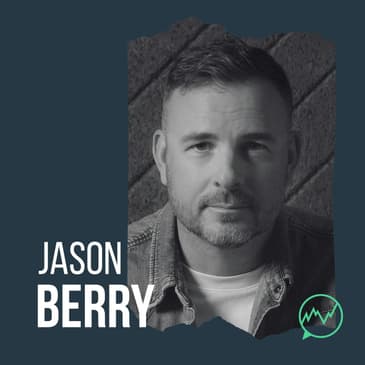
Jason Berry co-founded Positive Equity in 2008. Built alongside partners and traders who raised the bar, the firm operates trading floors in Ireland and Croatia. Over a 14-year stretch of verified clearing statements, his small losses, long career approach resulted in only five losing months.
Most people think trading success comes from predicting markets. In reality, Jason's multi-decade longevity proves that true consistency comes from deep discipline, strict risk control, and surviving long enough for compounding to work, earning him a featured chapter in Jack Schwager's book, Market Wizards: The Next Generation.
In this conversation, Jason pulls back the curtain on his journey from a remote Northern California commune to the chaotic trading floors of London and Dublin. He breaks down the realities of managing a decaying edge, his framework for identifying raw talent in trainees, and why surrounding yourself with a team of disciplined professionals is the ultimate source of career longevity.
In this episode, we explore:
· How Jason transitioned from an isolated childhood to the chaotic London trading floors
· The hidden edges of the open outcry era and the nature of "elbow trades"
· What Jack Schwager and the Market Wizards team look for when verifying a trader's record
· The structural reality of Jason's risk-reward framework
· Why summer vacations can cause traders to become rusty and lose touch with the market tape
· How to spot decaying market edges through the P&L before they do catastrophic damage
· The core personality traits and tells that separate successful trainees from those who fail
· Jason’s outlook on which traders will survive the next decade of AI and machine learning
About Jason Berry:
Jason is a professional futures trader, co-founder of Positive Equity, and a featured market wizard in the book, Market Wizards: The Next Generation. Over a career spanning nearly 30 years, Jason has documented a legendary track record of consistency and durability. He has trained well over 200 traders, expanding his operations from Dublin to Croatia while championing a team-driven approach to market mastery.
Links + Resources:
X (Twitter): https://x.com/JasonHBerry
LinkedIn: https://www.linkedin.com/in/jasonhberry
Sponsor of Chat With Traders Podcast:
Trade The Pool: http://www.tradethepool.com
Time Stamps:
Please note: Exact times will vary depending on current ads.
00:00 He Only Had 5 Losing Months In 14 Years
03:09 Introduction To Trading
09:33 Using Elbow Trades As An Edge
16:22 What Your Risk-Reward Looks Like
20:34 Can You Make A "Mr. Consistency" System?
25:29 What You Possess That Others May Also Have
30:23 Why You Get Rusty When Taking A Summer Vacation
35:56 How Important It Is To Constantly Innovate
38:51 What Traits You Can See In Your Trainees
45:10 The Single Greatest Rule In Trading
51:35 How Do You Scale Positions?
55:54 Which Traders Do You Think Will Survive The Next Decade?
59:45 Trading Euro Stocks
01:03:05 What The Next 30 Years Look Like For You
01:08:30 Have You Had Your Trainees Outperform You?
01:09:34 What Your Advice Is To Traders
01:14:11 Where Can You Find Jason Berry
Trading Disclaimer:
Trading in the financial markets involves a risk of loss. Podcast episodes and other content produced by Chat With Traders are for informational or educational purposes only and do not constitute trading or investment recommendations or advice.
Learn more about your ad choices. Visit megaphone.fm/adchoices
[00:00:00] What would your trading look like if capital wasn't the constraint? That's the reality for most traders. It's not skill holding them back, it's size. Trade the pool changes that. Step into the U.S. equity markets with up to $200,000 in buying power without committing your own capital. Full access to stocks and ETFs, long or short. Executed with the precision and freedom serious traders expect. Your performance is measured by one standard, disciplined risk management and consistent execution. Meet that standard and you operate at six.
[00:00:30] No subscriptions, no ongoing obligations, just a clear path forward. For those ready to trade beyond limitations, this is the next level.
[00:01:00] You can get a job credit at indeed.com slash podcast. That's indeed.com slash podcast. Terms and conditions apply. Need a hiring hero? This is a job for Indeed sponsored jobs. Trading in the financial markets involves a risk of loss. Podcast episodes and other content produced by Chat With Traders are for informational or educational purposes only and do not constitute trading or investment recommendations or advice. And I find the rule in trading is that if it is difficult, it's the right decision. Whereas if it's easy, it's the wrong decision.
[00:01:28] I'm writing that down. Generally speaking, the harder it is and more difficult it is to do is because you're fighting the natural human emotion or the natural human choice. And, you know, the natural human choice is to hold a loser and hope that it turns into a winner. And the natural human choice for winners is to take the money off the table as soon as it's showing green. I think one thing that stands out for me from when I started in the beginning, in the late 90s, early 2000s, it was pretty easy to be consistent and make a small amount of money.
[00:01:57] It was really hard to make big money. Whereas I find now it's much harder to get consistent and to get that baseline of performance. But once you're there, it's a lot easier to make a lot more money in these markets today than it was when I first started. I really think that surrounding yourself with other successful, talented, hardworking people rubs off on you.
[00:02:19] You rub off on them and that that continuing circle leads to people having greater levels of success than if you were trading by yourself. Markets, speculation and risk. This is the Chat with Traders podcast. All right, traders, welcome back to another episode of Chat With Traders.
[00:02:40] Traders, very excited for this one as today's guest is Jason Barry, a trader whose career spans nearly three decades across some of the most competitive future markets in the world. So Jason's first exposure to trading came as a floor clerk on the London International Financial Futures and Options Exchange during the final years of open outcry.
[00:03:01] From there, he connected with traders who brought him in to help launch a trading office in Dublin, an opportunity that became the start of a long and highly successful career in the markets. His early trading success quickly led to a second calling that is developing traders. So over the last 27 years, Jason's trained well over 200 traders with several going on to exceptional success themselves. He later co-founded Positive Equity. That began in Dublin, later expanded into Croatia, where Jason's now based.
[00:03:31] But really what makes Jason's record especially remarkable is the consistency. In fact, he's known as Mr. Consistency. We're going to dive into that. Over the last 14 years, he's only had five losing months. That's a level of durability and risk control very rarely seen in trading. Listeners may also recognize several other market wizards that have been on chat with traders, as now Jason Barry is going to be in the next market wizards book, The Next Generation.
[00:03:58] Other traders, Rick Bandazian was on episode 293, The Art of the Weight. Lucas Froelich, episode 259. Tessa and Ian interviewed them. And then Christian Kulamagi, episode 212. That was with Aaron. Aaron also interviewed Lance Breitstein, who joined Aaron on episodes 228, 229, and 236. So now Jason joins that select group of traders featured in the upcoming Market Wizards, The Next Generation. So Jason, congratulations and welcome to Chat with Traders. How are you? Yeah, all right.
[00:04:28] It's kind of weird to hear all those accolades. Yeah, I mean, incredible. I want to rewind time a little bit and let's learn about Jason from your youth. I mean, where did you grow up and what was your introduction to trading? I have an exceptionally strange upbringing. My parents were hippies, so I grew up on the side of a mountain until the age of about five or six in Northern California,
[00:04:54] maybe 20, 30, 40, 50 miles from a commune in the middle of the U.S. national parks. There was a piece of land that was carved out that my dad sold to other hippies. And there was a small community that lived around this place called the Forks of Salmon. What was that experience like for you? What was that experience like?
[00:05:18] Skinny dipping, barefoot, horseback riding, a type of farming, living off the land, no running water, hand pumped, electricity, non-existent, kerosene lamps, like little house on the prairie kind of stuff, but in the middle of the forest. And yeah, it was a, I don't know, it was kind of idyllic looking back. It was the late 70s. God, that makes it sound so long ago saying that. It was late 70s and there's just a big part of the population or a part of the population that just was escaping modern life.
[00:05:47] And my parents chose to live, yeah, in the middle of nowhere. The nearest gas station was 20 miles away. The nearest grocery store was 50. So how did you go about from living on the side of the mountain, isolated, to finding trading? I mean, what was your introduction like? Introduction was probably, I graduated from college and was looking at jobs overseas.
[00:06:13] I studied in France for a year as a high school student and I kind of got the bug or the desire in life to live overseas. I lived with a family and for whatever reason, they just really appealed to me living in Europe or living outside of the US. So when I graduated from college, I got my MBA and was looking for different jobs. One of them was working in Russia doing democracy building stuff.
[00:06:38] This is 98, so the wall is down and Yeltsin is in power. And there's a big open society, I guess, growing in Russia that ended up not going anywhere. But at the time was like a democracy building type job. The other one was with, what's it, JP Morgan or Morgan Stanley in Tokyo.
[00:07:05] Sort of like a IT slash finance job. I can barely remember so long ago now. And the other was working with my cousin who needed a clerk for his job on the, I'm not going to say the mouthful, but on, we call it LIFE, L-I-F-F-E. You said it earlier. And I was like, yeah, sounds interesting. Was in London. I could get an automatic visa for a year. There was an agreement between the US and Britain.
[00:07:34] And so I just went over and was his clerk for four, nine months on the floor, two years before everything went electronic. It was supposedly the most advanced trading floor in the world in that the trades were cleared. And I don't know if they were cleared during the day or within half an hour or an hour of the end of the day. But it was all still very much paper to computer. So traders would trade on a piece of paper or trade with each other, write down their trades on a piece of paper, handed to the clerk. That was me.
[00:08:03] And my job was to take it around the corner to the clerks that were inputting the trading data into computers. And a trader would do the exact same thing on the other side. And their clerk would do the same thing. Very interesting. So what was that experience like? And also, what was the criteria to be like a clerk back then? What kind of resume did you have to have? For me, it was just straight up nepotism. He was my first cousin, one of two, one of three, excuse me, one of four. And he needed somebody in short notice.
[00:08:33] And I was happy to fill in the role. His clerk had just become an actual trader on the floor. And so he was shorthanded. Most people who had clerkships on the floor were from around the city of London, the east end of London. Most would graduate from high school, get their, they call them A-levels, which is, I think it's a test, like the SATs or something.
[00:09:00] But I think you could finish high school at that time at 16. So there were a lot of 16, 17, 18-year-olds that were coming down to the floor looking to be traders or be a part of that environment, become traders or brokers. My cousin was a prop trader, was backing himself. And there were people that just wanted to come down and do one of those jobs.
[00:09:26] And the clerk role was the first role in the door to be able to have that opportunity to either meet somebody or to learn the ropes. Yeah. What was the experience like for you? I mean, comparing today to then, I mean, the electronic trading versus then, I mean, what was the comparison? The comparison, a total different set of skills.
[00:09:50] Your ability to make money was both a combination of being able to read the market and, well, that was probably secondary, was your ability to get good fills from brokers that were friendly with you. I think most traders would take brokers out on a regular basis for drinks or dinners or whatnot. So you're saying you would get better fills if you're more friendly with the broker? Yeah, because it's all open outcry. So people are looking at you, you're filled, you get five, you get 10, you get 100.
[00:10:23] And your ability to be friendly with the broker was an advantage to people who weren't friendly with the broker. Because you could get one price better when stuff was trading. And that was your piece of edge to stay into a trade or even just make a tick, just to flip the tick. That sounds like a significant edge. That sounds like a significant edge. And that was it. That was it. So what other, I mean, wow. What are some other edges that you've seen, I guess, exploited?
[00:10:55] I mean, they're called, they're called elbow trades. And you're standing next to the broker who's handing out tons of size or buying up stuff. And you get that half tick better than where the market's trading. And the market can trade two or three prices at the same instant. There are people that were watching the pits. I think they were blue coats or, I can't remember. But there are market surveillance.
[00:11:22] And they would make sure that there was, that people were following the rules. But there was definitely a lot of wiggle room for the way trades were handed out or traded with on the floor. But again, I was only there for nine months. So I'm sure there's. There's other corruption maybe, perhaps. You know, I was watching one of them. Corruption, but let's say inefficiencies. Inefficiencies. Okay. So here's another inefficiency. I was watching one of your other podcasts.
[00:11:50] And I heard you talking about how a floor trader from maybe London was calling in maybe to a floor trader in Chicago. And you could hear, right, the orders going through. And maybe there was the time discrepancy, right, where maybe you could get in before this whale got in. That kind of a thing. Is that an edge? Which perhaps that was even. Yeah, I know that. I know the instance you're talking about or the example.
[00:12:19] So back in the old days when you had to wear a suit to come onto the floor, it was super formal. You weren't allowed to have mobile phones. You weren't allowed to have computers or tablets, even though they did exist in the late 90s. And the exchange was very anti-technology. And little by little, it started to change.
[00:12:46] But one of the traders I saw didn't have his mobile phone but had an earbud or a headset or whatever the smallest form of headset was back then. And it was connected to some sort of transponder to somebody else's phone somewhere else in the building. And so he would listen to, I think it was in the guilt pit.
[00:13:08] He would listen to the US tenure and how the US tenure was trading in Chicago and have that immediate edge of what the tenure was doing. And the tenure, like today, would drive most of the bond markets depending on what was happening. So if, say, on nonfarm payroll, all of a sudden, 10 years up, 10 ticks, that's going to be a big move for the guilt. And that trader would have that advantage.
[00:13:38] I'm not sure if it was allowed or if people noticed or people cared, but it was definitely a very visible form of edge that that trader came up with. Wow. I mean, do you see anything today that stands out as an edge like those from back then? No. I mean, all the easy stuff is gobbled up. It's all in computers now, you know? Right. Yeah. And I want to get into that as well.
[00:14:05] But I want to ask you about becoming a market wizard now. Congratulations on that. What was that? It only took 25 years. Mr. Consistency for 25 years. I mean, how did you find out about it? How did that come about? How did it come about? A person over here organized a conference and invited Jack Schwager to come to Zagreb.
[00:14:33] And I heard about the guy who was organizing it. And I said, yes, definitely want to go to that conference, be involved. So we sponsored part of the conference and ended up meeting Jack at drinks or lunch. And I talked with him over the weekend and said, hey, if you ever do another book, give me a shout.
[00:15:01] I might have a number of people to send your way. And lo and behold, a couple of years later, he calls and I sent him. I solicited names from people that I know. Most people didn't want to be involved because they're traders and have a private life. And there's no appeal to be in the public eye at all.
[00:15:29] And one guy went through with the interview and in the end didn't want to do it either. And Jack asked me if I had anybody else. Again, same process. Found another guy but didn't want to be involved. Found one guy and he didn't qualify. And then Jack or George, I can't remember who, said, what about you? You've been doing this a long time. And I said, I'm a journeyman trader in my mind.
[00:15:56] I'll send you the stats and you guys can decide on your own. And I was kind of, to be honest, a bit sheepish about it because I don't necessarily see myself as a market wizard. There are days when I'm the best trader and those are not that often anymore. There's a lot of smart, talented guys around me. And there are years when I've been the best trader. But again, that has been a few years now.
[00:16:22] But I sent him the stats and it took a long time. So I don't know if you've seen any of the criticisms from the interweb about how people are qualified for this, for being in the book.
[00:16:36] But George and Jack went through 15 years of clearing statements and just poured over them to figure out whether I should be in the book or not. Yeah, I was going to ask, what does Jack look for? I mean, if we're in traders, but hey, you're spelling it out there. It really dives into the track record.
[00:17:03] Oh, no, they won't even consider talking to you unless you have official statements from the clears. So my back office sent over all the statements, had to dig back through. I don't think any of them are physical. I think they're all still electronic, but still 15 years of electronic statements. You know, I trade hundreds to thousands of lots a day as a lot of data for them to be going through. Anyway, so I got them all the data.
[00:17:31] They came back and they said, dude, you are the second most consistent trader we've ever looked at. Your stats don't make any sense to us. They're so consistent. We'd love to have you in the book. Wow. So consistency. And nearly three decades of it. Trading since, what, 1999? No losing years. Just a few losing months. I mean, how do you define risk in your own framework?
[00:18:01] I'm curious what your risk-reward really looks like. What does that number look like? Risk-reward. It's tricky because as a prop trader, you're trading a book. You're trading on behalf of the firm. You know, I have a certain amount of money that's down as risk capital. But it's largely down to the relationship with the clearer and their perception of your risk and profile.
[00:18:28] And because we're a collaboration of traders, our risk profile is lessened to an individual basis because we all trade in different directions and can have one trade on this way, another trade that way. And they all kind of overlap in many ways. And our outright exposure ends up being a lot less like an insurance pool, if you will. Like, you know, if you're an individual, your rate is X a month. But if you're part of a group, your rate is less.
[00:18:54] So looking at risk-reward on individual trades, it's hard for me to say. I can tell you my, you know, best months versus worst months, best days versus worst days are multiples of 5 to 20. Yeah. I mean, you don't put up with losses, it doesn't sound like. Like, it almost sounds like a ride or ride out approach. When you get into the trade, it's going to work or it doesn't.
[00:19:24] Is that fair? Well, I think probably the biggest fallacy out there is that every trade has, I mean, all trades have risk. But there are certain trades that you can put on that just, you know, are, unless there's some news that comes out why you got the trade on, they're just going to be winners.
[00:19:51] And I have a core set of trades that I know that if they trade, it's going to be a winner. And so it's not necessarily that my risk management abilities are, you know, awesome or that I'm super risk-averse. It's that my edge is really compelling. I am risk-averse, but at the same time, you know, I'm probably in the middle of the traders I see on a daily basis.
[00:20:18] I'm probably in the middle of the sort of risk-adversity personality of many people in the firm that are a lot more risk-averse than I am. And then there are plenty that are more risk, that take on more risk than I am, than I have. Give us an example of one of those trades for you that you have just a high level of confidence in. And do you size that disproportionately to maybe, let's say, you know, one of your other... Yeah, of course, you try and get as much of it as you can.
[00:20:47] The limit really there isn't how much I can manage, it's how much the market is going to give out. You know, when it's an all-but-guaranteed winner, the market isn't giving you thousands and thousands of lots. It's smaller lot sizes and more limited opportunities. Nobody likes giving away money. So, you know, I have half a dozen of these type trades that maybe come off once a week or twice a week,
[00:21:14] or maybe once a day, twice a day, but in smaller numbers. But overall, I have one that's, you know, I have them that they're coming in on a regular basis, as opposed to higher risk trades that you can put on at any time with any size, but the edge is a lot less and your risk reward isn't as good. Yeah, yeah. The more competitive a market, the more difficult it is to find the edge, the less competitive.
[00:21:42] But again, it comes really down to the research. And I can research certain trades and figure out that there's a high degree of winners before I even look at what the market is, how the market's actually trading in the order book. Hmm. You know, do you attribute that to experience? I ask that because, you know, we're entering a landscape now that's very systematically driven.
[00:22:09] But with your level of experience and consistency, like one would think, like, Mr. Consistency over here, I mean, that's really attributed to experience, right? Can you really even put that experience into a system? Where do you see that world going? Do you mean putting my ability to observe trades into an automated system? Yeah.
[00:22:38] Can you make a Mr. Consistency, I guess, model, AI program that can do these trades? Well, just size into these systems. Like, have the gut. The gut's this combined experience over time, right? That tells Jason, like, this is where you size in, this is where you size out. Now, I've watched some of your other interviews, too, where you discuss, look, like, part of your process is anticipating events. Like, you don't necessarily wait for the wars to happen.
[00:23:05] Like, you already have your plan in place in case, you know, in case whatever war is going to happen breaks out or if this ends. So you've predefined all this already. Can you put that into a system? Yeah, for sure you can. But my abilities and my skills aren't in programming black box or making an algo.
[00:23:31] My skill and my abilities are just executing the trade and identifying the trade as a human being. That means that certain trades are off limits to me. A lot of, you know, a lot of the algo are high frequency type trades. I mean, I do have some automated trades that I do execute. But by and large, it's more of a point and click. Again, it's a different set of skills to program and to build automated trading systems.
[00:24:02] Yeah. And one is, as one of the guys on the floor here said to me, hey, Jason, guess which one of the traders is the oldest of the traders in that New Market Wizards book? And, you know, rhetorical question. So I'm on the other end of the sort of programming and the algo set of skills.
[00:24:25] My skills were, you know, late 90s, early, mid 80s video game type skills and identifying, you know, using those skills in the markets as opposed to being able to program or work with programmers to automate the trading systems. Heard you discussed the video games too, where you've had some of your trainees actually play games, maybe for you to identify, you know, certain,
[00:24:54] I don't know, certain traits they may possess. Can you elaborate on that? Sure. We used to do it on a regular basis. I think we stopped doing it because I had kids and a wife and I couldn't stay late after work. But yeah, we used to play those large scale shooting games within the office on the LAN. It's very similar.
[00:25:20] It's a very similar experience, emotionally speaking, and that you are in a game versus other people. You know, they win or you win. You lose or they lose. You know, like, let's say in a sniping game or in a game where you can be a sniper, you can snipe people three or four times from the same spot, but eventually people are going to realize that you're in that spot and they don't like getting shot. So they figure out a way to get around that and to get to you.
[00:25:50] Same thing in the market. Nobody likes losing money. And if a trade you've done whatever amount of times keeps working, at some point it's going to disappear because nobody, again, nobody likes to lose money in the markets. The emotional roller coaster that you go through from losing in a video game versus losing in the market, very similar. Obviously, the costs are different. You know, it only costs you time and emotion in a video game, whereas in the markets, it's, you know, money's on the line.
[00:26:20] But I think the emotions are very much, and the way people deal with losses in video games versus the markets are very similar. Losses and success. Because losses are inevitable, right? I mean, whether in the game. Yeah, absolutely. It's just part of the game. It's part of the game. So did you realize that? You cannot avoid them. In 1999 until now, like, clearly, you just have something that other traders don't have.
[00:26:45] Because you've held the title of Mr. Consistency all these years. I mean, what do you possess? And what do you see in others? Because you've trained so many individuals. Like, what is that that you possess and maybe others have as well? Where is it just where there's no ego involved with the trades? Where if it doesn't work, if it's invalidated, you can take it off? Or you let your winners run? Or you size into your winners?
[00:27:12] What do you think it is about that you've had such high levels of consistency? And I guess to follow that up, what do you see perhaps in some of your trainees where you say, okay, they got this trait that really can progress them further in this, where you can see a trajectory there? Thinking about refreshing the carpet in your home? Now's the time to do it. For a limited time at The Home Depot, get 10% off installed carpet projects on trusted brands
[00:27:40] like LifeProof, LifeProof with PetProof Technology, Home Decorators Collection, and Traffic Master. Plus, with installation starting at just 49 cents per square foot, upgrading your space is more affordable than ever at The Home Depot. Offer valid June 11th, 2026 through June 28th, 2026. Exclusions apply for licenses. See homedepot.com slash license numbers. Ever watch a stock rip and think, I could have nailed that if I had real capital?
[00:28:07] The truth is, many capable traders never reach their potential. Not due to lack of skill, but lack of scale. Trade the Pool was built to solve exactly that. A firm designed for serious individuals who want access to the U.S. equity markets with meaningful buying power up to $200,000 without committing their own capital. Get access to virtually every stock and ETF. Go long or short freely with the flexibility professional traders expect.
[00:28:32] You're evaluated on one thing, your ability to manage risk and execute with consistency. Meet the standard, and you trade at scale. No subscriptions, no ongoing commitments. Whether you're still refining your strategy, a trader with experience who hasn't yet broken through, or a seasoned professional simply looking for more capital, Trade the Pool is built to meet you where you are and take you that next step further. The markets have evolved. Access has evolved.
[00:28:59] Now, so has the way traders operate within them. Trade the Pool. Where is Daredevil? On my hair. Don't miss the return of Marvel Television's Daredevil Born Again. So what's next? I've been liberated. We're gonna take this city back. Over Medicaid. In an all-new season now streaming only on Disney+. They're hunting us. It's time we started hunting them. I can work with them. That nobody could see.
[00:29:29] This should be tons of fun. Marvel Television's Daredevil Born Again streaming only on Disney+. There is a huge advantage to trading with other people around you. There is a huge advantage to being surrounded by smart, intelligent, successful traders that if you are trading on your own is denied to you. It is a huge advantage of joining a team that already has 10, 20, 30, 40, whatever.
[00:29:58] So you've always traded with groups of people? Yep. You've always? Yeah. Wow. I think it's one of the things we have on our walls is innovate together. It's such an advantage. And I don't work with everybody in the firm, but I have the guys around me that sit around me and we work together on figuring out the markets. And we are individually responsible for the trades that we make and for our performance.
[00:30:26] But we work together on figuring out edge and exploiting edge and trading strategies together. Yeah. But I would say that's the largest advantage in that when you are surrounded by other talented, intelligent, hardworking, successful people, that all rubs off on you and you rub off on them.
[00:30:49] And it's the opposite of a vicious circle, a successful circle that feeds on itself, that encourages it to continue. And I think it's one of the biggest advantages that people trading at firms have over people who are trading as individuals. Yeah, that's incredible. I mean, it makes sense. Trading in isolation can breed bad habits.
[00:31:17] I can very much see that where that makes sense. And you would know best out of anybody. Again, you've trained so many. I would say it's not necessarily bad habits, but you can take your foot off the pedal. You can get distracted by life around you. Because we wrestle with the same thing because now that trading is electronic, we do have a number of traders that are trading from home offices. Some that do both. I do both during the day.
[00:31:46] I'm in the office and in the evenings I'm at home. But I find there's a real risk to trading by yourself that doesn't exist if you're in the office. There's a greater chance of oblivion trading outside the office than there is for people who maintain and stay in the office and trade in the office and work with the guys around them, work with the people around them. Do you think it's sufficient enough to find chat rooms out there to be associated with?
[00:32:15] Because the lure for a lot of traders is that they can be to themselves. They can kind of escape the world. They can have this freedom to not go to an office. So what do you say to those traders? There are people who and we have a number of people in our firm that trade uniquely from home, but they are in the minority.
[00:32:40] And there's still a greater chance of oblivion trading at home than people trading in the office. There's a bunch of myths around trading. One, trading is liberating and lets you be your own boss. Trading, you can trade from home and enjoy the pleasures of home, office. It's get rich fast.
[00:33:06] You know, all those sort of all those myths that are out there that really aren't true and are, I don't know, maybe been created by TV or by movies. The one, you know, be your own boss and work at your own leisure. And people who do that aren't really very successful for very long or never even attain success. You know, I take off a lot of time in the summers, but man, it destroys my ability to trade by the time September comes around.
[00:33:35] And I have a huge ramp up time where I have to trade small and, you know, get back into the rhythm of trading. So pretending that you have to work less hard at this career as opposed to another career, like that's just a myth. So why do you think that is for the summer? Do you think it's like you get rusty or do you think it's just the market changes and you have to kind of adapt to that? Absolutely both. Absolutely both. You get rusty and the market changes.
[00:34:04] You're not tuned into what the news cycle is. You're not tuned into the full risk on or risk off environment. You're not tuned into what's actually moving the markets. The markets have changed. The fills are coming through differently. The trades are coming through differently. Whereas when you're when you are seeing the market every day, you're witnessing the small changes to the market.
[00:34:36] Whereas if you're away from a week, you've missed those five days where you're awake, where you're away for two weeks, you've missed those 10 days. And those little changes over time add up to big changes that are harder to adapt to. All right, Jason, I'm going to try to get you to divulge your secrets here again from the 1999 on. Good luck with that because all of my all of my traders enjoy your podcast and will murder me if any pieces of edge come out.
[00:35:07] OK, let's try to get OK. Let's maybe discuss then a prior like you've alluded to that. Maybe the edges change over time. So can you discuss maybe edges you've traded in the past with that can add value to the traders listening that maybe they can apply to their, you know, their own future? Yeah. Some of some sure edges. Let's see. Well, I'll tell you one edge is not allowed anymore in the past.
[00:35:39] The and I think maybe this is why Bitcoin was so big for a lot of trading groups over the last few years is that in the early in the late 2000s, there were no market manipulation rules. There were no market. Mar what's it called? I should know that off the top of my head. And so I know I know a lot of traders that push size around in order books to get trades
[00:36:05] off that they wouldn't otherwise be able to get off through manipulation of the order books. I know one guy in Chicago who did it until the rules were put in and then he just retired a millionaire. He just stopped trading, didn't even try to trade beyond that. But in terms of edge that used to work, well, news used to be edge. You know, you would hear the news through the TV. I remember watching September 11th and or not watching it and that traders that were
[00:36:35] downstairs had a TV and those of us who are upstairs, we didn't have a TV. And those traders that had the TV watched the they saw that they didn't see the first plane. And so there was just market chaos. But they saw the second plane and all the traders just unloaded everything once they saw the the images of the second plane before it even hit the building. So information edge used to be massive, massive edge.
[00:37:01] And you could like on the TV, never mind some special news service or Bloomberg or Reuters. And now the news, that kind of news release is not really an edge anymore because it's gobbled up by the high frequency algo that are programmed to absorb that, absorb that edge. I think in one of the previous Market Wizards books, one of the one of the guys described that that edge.
[00:37:31] But stuff that won't get me in trouble with the traders and in the markets. I'd say, you know, the biggest thing is just to get out there and innovate and to spend time and spend time in the markets and to look at to watch markets. And the better you know them, the better you are able to trade them.
[00:37:59] Yeah, I believe that the first example you gave got cracked down on. I think it was 2010, like spoofing orders became illegal. But like you said, there was an edge there where traders capitalize on and then maybe became too competitive like the example you're given where it's like, OK, I'm done with this, you know, after being able to take it. It wasn't even competitive. You go to jail. Or you get fired. Right. Yeah. Post 2010. Right. But prior to that.
[00:38:28] I can't remember when the rules finally came in. And I know that some traders used to trade. They knew there was a spoofer who was active and they would trade against him as best they could, knowing that he was spoofing the markets. And so they weren't spoofing the markets themselves, but they would see the spoofing going on and they would trade against that trade or with the trader. But they would be active when that guy was active in the markets. Right. Yeah.
[00:38:58] You know, you've mentioned that innovate word a few times. How important is it over your creed thing to just constantly be innovating? Because there's this, I think there's this, traders think, you know, I'm speaking for myself, you know, first starting where you think there's this finish line maybe, you know, you where you just make it and you no longer have to innovate any longer.
[00:39:22] So how important do you think it is to continuously innovate and work on yourself? The thing I say to all my guys is that treat yourself as a trainee, whether you're one year in, whether you're 10 years in, do all the things that got you successful in the first place. You know, everybody's got that initial, for us, it's, you know, two, three years before people are getting to a base level of success.
[00:39:50] And those two or three years are them killing themselves to figure out the edge. You know, the first year is just learning curve of, you know, all the basics. But eventually you get to the point where you're, you know, a full-fledged trader and you're starting to make money. But to get to that point, you know, you're, you're killing yourself, look, you know, watching markets, spending time in front of the screens, you know, watching the tape as the old, I think that's reminiscence of a stock operator quote.
[00:40:18] Watching the tape is, is, is, is so basic, but so much part of the best trading advice you can get, it is, and, and the cost of that is time. And I think that's the, the, the problem for most people in that they don't have enough time to get to a point where they've actually watched the tape for long enough that they can actually start seeing things.
[00:40:46] I believe as with most things to become a professional and to become a, a high performing professional in, in trading, there's that 10,000 hours equation that, can't remember which book it was, Bounce. Actually, I think it was Bounce. Bounce, that might have been another book, but there's, there's a concept. You got to get 10,000 hours before you become a real professional at something. And once you've had 10,000 hours of being in front of the screens and observing the markets,
[00:41:15] you get to a certain level of comprehension where you know which trades are good, which trades are bad, which trades are dangerous, where to size up, where to size down. And you see repeating, repeating patterns and repeating events, repeating scenarios that you know how to react to. And if you do the math on 10,000 hours of, you know, working eight hours a day or 10 hours
[00:41:40] a day or killing yourself and working 18 or 20 hours a day, it's still a lot of years to get to that point. That's not saying that, you know, once you're three, four years in that you're not going to be start getting to a certain level of success. It's just saying that once you get to, you know, the 10,000 hours, there's a much higher degree of success, a much higher level of success.
[00:42:06] But most people never get to that because they just don't have the time to spend seven, eight years working on something that isn't paying off enough for them to put in that time. Yeah. Jason, what traits do you see, maybe personality traits among your trainees when they get signed up with you? What can you see early on where you say, hey, this is, they have it. They have something here that can really take them to that next level. That is a hard question.
[00:42:36] I think for every firm that's out there, there's a different set of criteria that they look for, that we look for, and nobody knows for sure what the magic set of traits is. You know, we kind of do our best in what we think, but we regularly get guys that don't match our set of criteria that become successful.
[00:43:06] But in general, we look for high performers in everything that they've done from high school and college to competitive sports. Historically, we've looked at poker and competitive games, including video games. But anything where people have had to have a disciplined life and lifestyle choices that
[00:43:35] force them to be disciplined with their approach to their studying, their job, their sport, their competitive activity, and illustrate a high level of performance in whatever the activity is that they did. I like seeing activities where people have to beat other people, either outthink them or
[00:44:05] outplay them, not just outstrength them or outendurance them. Like somebody that runs, does ultra marathons, like fair play for you beat other people, but it's less down to you outthinking that person and more down to, you know, your practice and your life discipline before you get to that point. You know what I mean? Right. I'm hearing innovation, thinking of innovative ways, you know, to beat them. Yeah. Just clever ways to outthink your opponent. Yeah.
[00:44:35] You know, you go one way, they go the other way. It's, but in games and activities where you have to outthink your opponent as opposed to out endure them or out discipline them. Are there behavioral tells for you where you think, okay, they, the reaction to a loss, perhaps, you know, is your, or maybe they're not very curious. Those are the easiest. Those are the best. Okay. Those are the best. That's the best tell ever.
[00:45:04] And it's only come every once. It comes every once in a while, but those are the easiest. We once, I was once trained a guy and he could not cut his losers. And I went through with him for about a month and a half. And, uh, normally people where I work with for, you know, somewhere between a year and two years before they either make it or they don't make it. And this guy, after a month and a half, I was like, dude, you just don't have a man. You just can't cut your losers. And I got to let you go.
[00:45:33] And this was before, uh, before simulation. So he was actually losing money in the markets. So he left, went to another firm. And, uh, I heard like a week or two weeks later that he had like a thousand euro day. And I was like, did I make some mistake? Did I not see something in this guy? Maybe, you know, he was, I made a mistake and he, uh, he clearly could trade. And then, you know, the next couple of days for it, he had a couple of two and three grand
[00:46:01] days and then four and five grand days and then 10, 15 grand days. And I was like, oh my God, what have I done here? I've totally blown it. Let this guy go. And, you know, I let a whale go. So, and then, uh, about two, maybe three weeks after he left, then it came, he was down 180, 190 grand and, uh, had been spoofing in the S and P and the NASDAQ.
[00:46:27] The new firm that took him on didn't have his limits incorrectly. And he had unlimited orders to play with in the markets. And, uh, yeah, he did. So he didn't make it, but, uh, those are the easiest to find, uh, less, less, less easy. Um, I had a class of, uh, three guys. One of the guys would always cut the, uh, loser too soon. We had amazing discipline and was super tight.
[00:46:56] The other guy was, uh, looser, but still knew when to, to cut. Um, and the third guy was always cutting 10 or 20 or 30 or some amount of time, uh, later than the other two guys. And he ultimately didn't make it. And it was, it was seconds difference between the three cuts. Let's say the first guy would cut it at 10 seconds. Second guy would cut it at 20. And the last guy would cut it 30. And that guy just never made it.
[00:47:23] He, uh, he couldn't, he couldn't cut it for whatever reason at the right time early enough before it did too much damage. Um, but those are the easy, that's an easy one to define. Once you find one of those, you're like thankful. Oh, thank you. That's an easy, uh, an easy decision. The, the, the, the most difficult is somebody who works hard, is disciplined and like does everything you, that you ask is super coachable, takes on all feedback. Um, those are the most difficult because at the end of the day, you got to perform.
[00:47:53] And those guys that don't perform, you give the most amount of time when somebody does everything right and, and listens to you in every, every way possible and works as hard as hard as they can. Those are the most difficult because they're doing everything right, but they're just not figuring it out. Um, one of the easiest, uh, to, you know, one of the easiest traits to see is just work ethic and time in the office, time in front of the screens.
[00:48:18] Um, you might even argue it's the, the most important above intellectual ability, above, uh, you know, natural talent. Some people don't believe in natural talent. Um, and that the work ethic is what gets you, gets you through the hard times. Hmm. What do you think the single greatest rule is in trading? This is Kevin. We hope you're enjoying this episode so far. If you are, take a second to leave a comment.
[00:48:47] We read them all and truly care about what you think. And if you haven't yet subscribed to our email list, visit chatwithtraders.com and click subscribe so we can keep you posted on information that matters. Now back to the chat with our guest. Single greatest rule. Oh man. Um, single greatest rule. I think, uh, alpha trader, uh, author, uh, Brent Donnelly said it best.
[00:49:14] Uh, traders, uh, traders need to have, let me get this right. It'll misquote him. Uh, traders have strong opinions loosely held. Okay. Yeah. I wanted to ask that after your examples, because it sounded like what's going on is, yeah, just not cutting the losers, not cut the, you know, you have the traders that are not cutting those
[00:49:43] losers and letting the winners, letting the winners. To be honest, that's probably the smallest of, uh, the, pretty much everybody that gets to this stage of the game has read every book, knows all the core principles. Everything that can be taught from a book is known. Um, it's available to everybody. It's out there on the internet. It's out there in books. Everybody knows that that's the, that that's the game.
[00:50:06] Um, and very rarely do I see that as a, as a pro, as a problem with people that get indoor to where we are. We're working, um, with them, but a single greatest rule, maybe the single greatest rule is there are no single greatest rules. Everything, everything needs to be taken together and worked on together from, from risks to edge to work ethic.
[00:50:33] Um, but yeah, again, if you, if you're not taking care of any one of those, all the other ones don't, don't work. If you don't have edge and you're just, but you have amazing discipline, you're just managing a slowly rotting, you know, pile of capital. If you have, uh, no discipline, but you've got edge, again, there's the other set of problems. They all, you know, they all work together. So having the edge, having the discipline, having the consistency to compound, they, they all
[00:51:01] kind of work together, but there's the one of them, which you say is constantly changing and you have to keep innovating. And that is edge. I'm curious for you. What, how do you, at what point do you realize, okay, this edge is becoming decayed perhaps. And what signals that to you to the point where you say, look, I'm back in the, losses, man, losses signal that dude. No longer. After what period of time? How many losses? Sure. Sure.
[00:51:31] I don't think there's a specific rule, but you know, you go to the trade and the trade either doesn't line up and it just, it's not there anymore or just lines up a lot less frequently and the edge just slowly disappears with, without losses. You're just not making any money. Some trades are lining up and you think it's good, but it just goes bad. I've got a few of those at the moment that I'm wrestling with. And it's hard because you get pretty attached to making money in certain parts of the day.
[00:51:59] And when one of those pieces of edge starts going away, you've got to keep eye on it. You drop size. You manage it like any other losing part of life. You restrict yourself to trading it, how you trade it, tighter downside. And then ultimately you've got to sort of make the call or just be more patient or trade it in a different way.
[00:52:23] You know, it might be a fading strategy that just works forever and ever and ever. And then all of a sudden it stops working and then maybe the trade is then to just go with it. But it's, yeah, it'll be losses, frequency of the trade. I had this one trade that I used to trade the VIX and I used to trade it in pretty big size. Size that terrified the risk managers. And I would, a lot of times I would have them on the phone in case I lost connectivity or something.
[00:52:53] The risk was so big that I just wanted to have an out to be able to delete orders. But this trade would line up two, three times a week, six, seven, eight times a month. And I could trade really big size. And then the Ukraine war started and that trade vanished, never came back. And I was trading this for, I don't know, two, three, four years where every other day the trade was there.
[00:53:20] And the first, second day of the most recent Ukraine war, or I should say the Russian invasion, that edge just disappeared and the trade came back maybe one or two times over the next maybe three or four months. And then it never came back again. Sometimes it just disappears. You know, either a market participant is trading in a different way. A market participant realizes they're trading in a bad way.
[00:53:50] Or just some scenario where it was working, changes, and the trade is gone. I'm sure your students would love you to expound on that edge since it's no longer around. Tell us a little bit about it. Are you free to or not this one? It was a reoccurring order. Somebody would come in every 10 seconds or 20 seconds or 30 seconds at a specific time of day
[00:54:17] and would buy a random amount of size. They were trying to, it looked like they were trying to hide the size, but the frequency at which they were coming to market was the same. So they might trade a 25 lot and then a 35 lot and then a 50 lot and then a 10 lot and then a 5 lot. But it was coming in every 10 seconds or every 15 seconds or every 10 to 15 seconds. They would try to put in like a randomized entry time,
[00:54:46] but you could still see it because it was just really, it was, they would come in at a quiet time of day and you could see the orders coming through and you could trade with them. They were moving the market because they were coming in every 10 seconds and they'd have a pretty big size to do and that would move the market and you could go with them. And then at a specific time of day, they would just stop. And that's when you liquidate and you reverse?
[00:55:15] I would liquidate and sometimes reverse, yeah. Liquidate and sometimes reverse. Oh, incredible. Now, when you saw us, like for this edge specifically, let me ask, how do you scale these positions? Are you kind of putting multiple lots out there as well? Are you going single entry? How do you manage that position? I would say I mostly go single entry and there's some trades that I should scale and I need to scale more with, but that's a constant wrestling.
[00:55:44] That's a constant challenge, I think, for traders is to add to your winners. Yeah. Whereas adding to your losers seems to be really easy. It's almost like a natural instinct to just want to sell at 10 and then, ooh, 14, that's an even better price to sell at. That's even higher.
[00:56:11] Whereas you sell 10s and now it's at 8s, now it's at 7s, 6s. Adding to that winner is more psychologically difficult. Yeah. And I find the rule in trading is that if it is difficult, it's the right decision. Whereas if it's easy, it's the wrong decision. I'm writing that down. That is so good. You know, we had on Eduardo, another guest here recently,
[00:56:38] and he said, you got to make yourself uncomfortable because that's when you grow. And you're saying something along the same lines. Like if it's uncomfortable, likely it's the right decision. But, you know, it makes sense because why would that be? If you think, if traders, if you want to be not among the 90% of traders, you got to kind of do what the 90% are not doing. And that's exactly what you're saying. Like this is not comfortable for me to do. Therefore, I should do it.
[00:57:08] Generally speaking, the harder it is and more difficult it is to do is because you're fighting the natural human emotion or the natural human choice. And, you know, the natural human choice is to hold a loser and hope that it turns into a winner. And the natural human choice for winners is to take the money off the table as soon as it's showing green.
[00:57:35] And that's the classic human emotion scenario. But there's lots of these in trading where it's just difficult to put on the trade. Either the market's moving too much or the order book looks like it's stacked against you. You know, pullbacks looks like it's changing direction where it's actually just a pullback and, you know, how do you know? But generally speaking, like you said, the harder it is to do, usually it's the right answer.
[00:58:04] And that's where systematic traders would come in and say, you know, start developing, you know, that systematic approach. And I know you said you have some trades that you're taking that approach as well. How many edges, I'm curious, how many edges do you trade? Do you currently trade? I got about probably 20 to 40 different types of edge and trades that I do in an average day. Incredible. And you kind of break those down into different...
[00:58:34] I like the poker analogy, right? So do you break those down into, oh, this is pocket ace. I'm putting more risk on. This is pocket two. Oh, yeah, for sure. And two offsuits. Oh, yeah, absolutely. You know, there's some where I will take as much size as the market will give me. There are some where I'm trading at one lot in the S&P, you know. So it very much depends on the piece of edge that shows up and the advantage that is available from my own research
[00:59:03] and the dislocation that's actually in the market. So I'm curious for you, Jason, like the market's ever changing. I'm curious how you see the future of trading going, if there's room for, you know, point and click traders in the future with the way AI is going. Or for example, you know, we have the PDT rule here in the US changing. So there's going to be more traders, more availability for traders to trade.
[00:59:32] So do you think edges are going to be more systematic over time? Is there room for discretionary traders? And what traders do you think are going to survive over the next decade? How do you see the landscape? Sure. Markets are always going to go up and down. So there's always going to be opportunity for people to trade.
[00:59:54] Edges will change, you know, just like when trading, electronic trading first, you know, the transition from the floor to electronic trading. Some people made the transition. Some people didn't. And then you had the change when it was everybody was point and click and the first days of electronic trading. And then slowly people started building algorithms and automated trading. And that changed the way the market moved and trades that were available on point and click.
[01:00:24] For point and click people, you know, a bunch of those disappeared and evolved into some other trade. But a lot of people weren't able to make that transition. And then you've got AI for sure involved, machine learning for sure involved. But, you know, at every stage of sort of that trading evolution, some people have maintained their abilities in the market and adapted and maintained. And other people haven't.
[01:00:55] I think that whole, you know, training, keeping you staying in the trainee mindset helps people adapt to the new scenarios when old ways of trading stop working and new technologies come in and change the landscape. But I think the markets are always going to go up and down. And algos aren't some perfect, you know, terminator robot, you know, market killer. They make mistakes as well.
[01:01:22] You know, the algos and the automated trading systems are only as good as the people that program them and come up with the ideas and concepts on how to execute those algos and high frequency trades. So, you know, algos still make mistakes and we pray on algos and hope for algos to make mistakes in the markets as well.
[01:01:42] And then when the markets get busy, like the last month and a half or so, you know, a lot of times algos pull out and high frequency traders and the automated traders will pull out and the markets get a lot looser and more opportunities show up because the volatility is so much higher. And their algos and high frequency trades aren't built to deal with the level of volatility that the markets have seen.
[01:02:06] So I have no doubt that trading for whatever style you have is always going to be available and there to participants. Markets aren't going away. If anything, they're becoming deeper, bigger and more available to people. And for creative, hardworking, innovative people, you're just going to find more and more opportunities.
[01:02:31] I think one thing that stands out for me from when I started in the beginning, in the late 90s, early 2000s, it was pretty easy to be consistent and make a small amount of money. But it was really hard to make big money. Whereas I find now it's much harder to get consistent and to get that baseline of performance. But once you're there, it's a lot easier to make a lot more money in these markets today than it was when I first started.
[01:03:02] 1999 versus now. What do you attribute that to? Is it the increased volatility? Because you've lived through some very volatile times, you know, with the 9-11 and then 0-8. You've traded through those and then COVID. Do you think it's the increased volatility? I think it is a mix of increased volatility in the market. You know, I'll give you one example.
[01:03:30] I used to trade the euro stocks in Europe and it would have a daily range of, you know, 15 or 20 ticks, 15 or 20 prices. And now it has a range in excess of 100, 150 prices on a regular basis. So volatility is definitely much higher. And I think volume is much higher.
[01:04:00] And that you're able to get off a lot more size than it used to. In that euro stocks example, I remember 100 lot being massive size in that. And you could lean against it and sell in front of it until it got down to, when you watch a trade, it goes down to 90, then down to 80, and then to 70, and then down to 60. And when it gets to 60, you cover your position. And when it gets to 50 and then 40, you reverse the position. And then it goes. Whereas now, 100 lot is invisible in that market.
[01:04:29] And you can trade hundreds anytime you want. So I think the mix of volatility being greater, size being greater in most markets. And then there's also diversity of markets. When I first started, we probably traded four different markets. And now, you know, I'm looking at six, seven, eight different exchanges in front of me and hundreds and hundreds of markets.
[01:04:58] So its size and scale is much greater on almost every measurement. And you're very prepared, you know, from doing the research. The next event's not going to surprise you, is it, Jason? I mean, you've talked about you're very prepared for whatever the world brings. And your reaction, you don't have to necessarily think about it because you've already thought about it.
[01:05:28] That's the ideal. But again, that's probably an area I could probably be more disciplined with is my preparation for specific events. You know, you generally look to see how stuff is traded in the past to give you an indication of what it's going to trade like in the future. And you get event scenarios in your mind written down to tell you how a market is going to trade or not trade.
[01:05:57] And then your preparation tells you that when that news kicks off, instead of thinking about, you know, spending the 10 seconds or 20 seconds or two minutes to think about how is this? How is my market going to react to this news? You've already thought about it and you're just executing. Yeah, it's brilliant. So you've traded now for nearly three decades. I wish he'd stop saying that, man. Well, hey, it's the wisdom and the experience.
[01:06:25] And I'm just curious what the next three decades, what do they hold for Jason over the course of the next 30 years? And then, you know, what keeps you so passionate as well? I mean, is your passion now just as strong as ever? Or are you more passionate now about training, you know, the next generation of traders? What's the next 30 years hold for you?
[01:06:57] I think I'm a dopamine junkie. And I just love clicking the mouse. Trading is like video games. It's like getting that hit from, you know, watching your Facebook or Instagram page or text messages coming in. There's a certain amount of like, I won't say addiction to trading, but there is a pleasure that is definitely dopamine related to trading. And it's the same. Like I really enjoy video games.
[01:07:26] My wife does not enjoy that I enjoy video games, but I really enjoy video games. But I understand that they are pleasurable to me because of the effect that the body generates dopamine and the brain likes it. And I think trading has a certain degree of that as well. But I've always just been involved in competitive sports or competitive activities, whether it's basketball, baseball, tennis, whatever.
[01:07:54] Trading and video games and competitive card games was never super into poker. I mean, I played at the casinos with my family and stuff. We'd always go to blackjack table, but I didn't. I never liked playing the way they liked because I always knew that even if we were playing blackjack, the best odds in the casino. This is before Texas. Oldham was there. The odds were still not in my favor.
[01:08:20] And so they would go crazy in the casinos and they would all, you know, spend their allotted 200 bucks or whatever. But I never got I would play with them, but never with the same passion because I always knew the numbers were against me. Whereas in trading and in sports, in video games, you know, the the the playing field is level in many regards. Obviously, in sports, you know, you can't be playing with pros if you're not a pro. But I just love the competition.
[01:08:50] I love the competition with the other guys in the office in, you know, trading with with trainees and and hearing how they have developed. And seeing that I put on the trade and they put on the trade. And even though they might be a different amounts of size to see, you know, what did I hold? Did I hold to the to the right exit spot? Did they hold to the right exit spot? And it's not that I'm happy that I beat them, but I'm happy that I competed with them and enjoy that process of of friendly competition.
[01:09:19] And sports, games, trading. All of those all of those have that element of competition. And I'm 50 years old and playing basketball twice a week. And none of my family understood. My wife is like, why? Why do you play? And I just I just love the competition and I love the the the teamwork required to play basketball. I love the teamwork that's required to trade and that just sense of competition and teamwork and then achievement.
[01:09:50] Like, you know, the last month and a half has been really good in the markets and all of your work, both for me as an individual and all of my work with the with the guys around me. Really, you can really see it come to fruition when markets like this kick off and trainees go from being trainees to becoming, you know, full blown traders because they've gotten a hold of the markets and done things that even I didn't do. So it's really great to see that progress.
[01:10:18] But that again, you know, I said it earlier about trading in a team environment, trading in an environment where there's other people around you. Yeah, I think I just I really enjoy being part of a team and what the team accomplishes. And, you know, you compare yourself a little bit to the guys around you, but it's friendly comparison. And you know that if you are you know, there's some guys that just always outperform you and there's some guys that always underperform you.
[01:10:44] And if the guy who underperform you underperforms you normally outperforms you, you kind of, you know, you ask yourself questions like, what did I do right? What did I do wrong or maybe it's less about me and it's just more he had a great day. I just really enjoy the, you know, friendly competition environment. And trading is where you, you know, you put your brain and your balls on the into the market and you get out a specific result.
[01:11:10] And whether that's just pride of ability or it is the dopamine talking, I really enjoy that, that this type of environment. You know, I've heard of this, you know, the dopamine rush is certainly there. And I caution, I've always cautioned traders, you know, with that where certainly you can, you can be cognizant of it and it not be used as a weapon against you.
[01:11:36] But there's this thing called a scarcity loop, which is certainly falls under. And you actually pointed that out as well with, you know, social media, how you you have these three components of it. That is quick repeatability, random results and opportunity that's present. And if you think about those three, it's not just casinos, slot machines, Facebook, TikTok, all the dating apps and like, yeah, everything can fall in that category.
[01:12:06] And so we just have to really be on our guard that, you know, we're applying the discipline. Yes, there's a dopamine rush, but yes, we also have to apply that discipline, you know, as well. So I'm curious for you, though, is have you had any of your trainees outperform even you? Absolutely. Yeah. My my partners always are always telling me that, Jason, we are being a successful firm is when trainees and traders are outperforming you.
[01:12:34] Oh, yeah. No. On a on a regular basis, you know, I I might be the the face of this firm and I'm here talking to you because I'm in the book. But I think there would easily be, you know, another two or three or four guys that could easily be in the in the book and the trade as well. If not better, definitely trade better than me.
[01:13:01] And I've had the pleasure of reading your part in it. It's excellent. It's coming out June 2026. For those that are watching either prior to that date or after, make sure you preorder or order that book. It's just an amazing, amazing, incredible read. It's going to add tremendous value to your trading. So lastly, Jason, I want to ask you just your advice for traders trying to build longevity. Final words over to you. Boy, that's a that's a big question.
[01:13:28] I probably say that the shortest and most difficult answer there is get yourself inside a firm. And that is the I think that is the single greatest source of edge and longevity that you can do as an individual and do it in an environment where you have lots of time to develop as a trader.
[01:13:52] And if you get to a certain part in your career after being with that firm for a number of years that you say, OK, the firm isn't giving me the value that I want and maybe I'll go somewhere else. But I really think that surrounding yourself with other successful, talented, hardworking people rubs off on you. You rub off on them. And that that continuing circle leads to people having greater levels of success than if you were trading by yourself.
[01:14:20] Now, the difficulty is that there's not everybody has access to a firm in their in their town or their city or wherever they live. But doing your best to. Solve for that problem and moving to a place where you can get jobs at firms is, I think, the. The. The.
[01:14:42] Solution that I would encourage people to to attempt if you can't do that, then you're on a you're just you're at so much of a disadvantage compared to other participants in the market. You know, when you go to a firm or speaking even from just my own firm stats, if we hire you, it's a forty.
[01:15:03] Six, forty, fifty, sixty percent chance that you're going to become a successful trader to some degree, whether it's, you know, low, medium or high levels of success. You will get to that level of success, you know, four or five, six people out of ten. Whereas if you are trying this on your own. You're looking at one out of one hundred, one out of two hundred, one out and, you know, at worst, one out of a thousand.
[01:15:30] You know, there are lots of people that attempt this because trading is so prevalent and so easily accessible these days that I think everybody gets the impression that it's easy to do because you can have all the tools in front of you. And you give this yourself sort of a false hope that just because I have all these tools in front of me, I am in the position of being successful in the long term, whereas that isn't the case for most people.
[01:15:57] That's not not saying that, you know, there are there are those one in one hundred or one in a thousand people that do become successful. And I think there are I think there are even a couple in the in the market wizards book, but that the odds are very, very slim and that you want to do everything you can to make those odds more in your favor. And I think the best way to do that is to find yourself a firm or.
[01:16:23] Maybe even just find yourself a small group of people that you can work with, that you can learn from each other, develop and just be surrounded by other smart, successful people. Incredible. And traders, we should certainly listen to Jason because he is Mr. Consistency. So he knows what he's talking about.
[01:16:44] The results are incredible over all these years, specifically because, I mean, the markets have changed so much, you know, from the outcry to the electronic trading to algorithm. But, you know, the one thing traders has stayed consistent in all of that is Jason's level of performance.
[01:17:03] So his trading, especially around risk control, innovation, which was pointed out many times, and that trainee mindset that we've discussed here in today's episode really challenges the idea that experience alone might actually be enough. It's clear, Jason, that in your world, Edge isn't something you find once. It's something that you just keep rediscovering over and over and over again.
[01:17:29] And I think your perspective on building traders is just as valuable as your own trading. Training so many, you know, hundreds of traders and seeing how different people respond to the pressure loss opportunity and what separates those who make it from those who don't. So, Jason, we really appreciate you taking the time today to share your journey, the insights, all the great valuable lessons that you've taught us here today.
[01:17:56] So for those listening out there that want to follow your work, where can they find you? Twitter and LinkedIn. I think Jason H. Berry on Twitter and Jason Berry on LinkedIn. Perfect. Well, Jason, thank you so much for coming on Chat with Traders. Hey, thanks for having me. Keep doing a great job.
[01:18:20] I know all of myself and all of my traders, we love listening to the episodes and learn just as much from you as we do from ourselves. Thank you. We appreciate you. Take care. Take care. You've reached the end of this episode of Chat with Traders. But rest assured, there are more episodes loaded with real market insight and zero hype on the way soon. So to stay updated with each great new release, subscribe to the podcast and we'd love it if you'd leave a rating and review.
[01:18:47] We'll catch you next time on Chat with Traders.